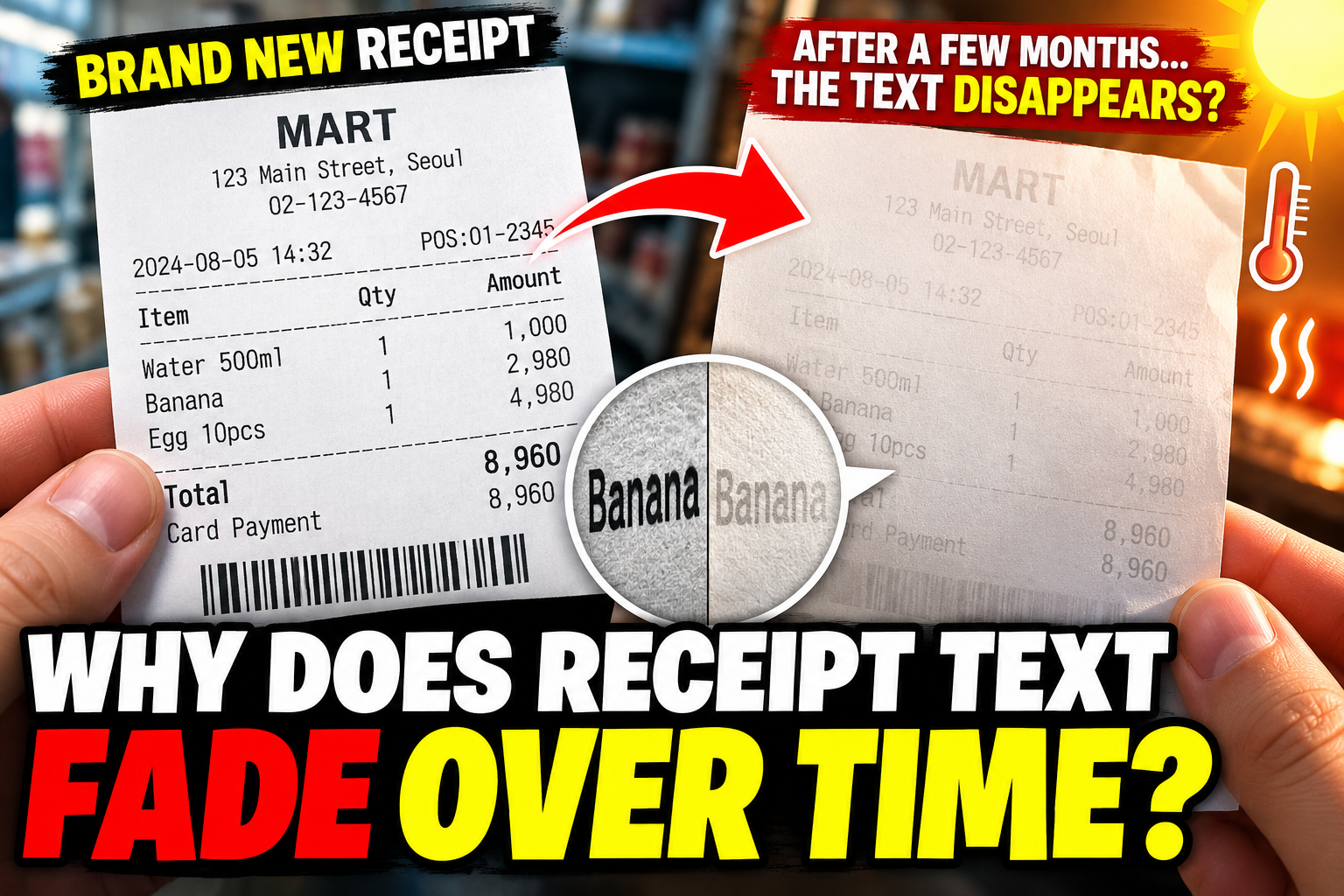
Have you ever found an old shopping receipt in your wallet, only to discover that the printed text had faded or completely disappeared?
Receipts often contain important information, including purchase dates, product names, prices, and payment details. However, unlike ordinary documents printed with ink or toner, many receipts gradually become difficult to read.
Sometimes, the text disappears after several months. In other cases, exposure to sunlight or high temperatures can cause noticeable changes much sooner.
Why does this happen?
The answer lies in a special material called thermal paper.
Unlike ordinary printing paper, thermal paper contains a chemical coating that changes color when exposed to heat. This technology allows receipt printers to produce text without using traditional ink cartridges.
In this article, we will explore how thermal paper works, why receipt text fades, and how to preserve important receipts for longer.
1. What Makes Receipt Paper Different From Ordinary Paper?
Most traditional printers use ink or toner to produce text and images.
Inkjet printers spray tiny droplets of ink onto paper, while laser printers use toner that is bonded to the paper through heat and pressure.
However, many receipt printers found in supermarkets, restaurants, convenience stores, and parking facilities operate differently.
They use a process called direct thermal printing.
The paper used in this process is known as thermal paper.
Thermal paper has a special coating containing chemicals that respond to heat.
These chemicals are designed to remain relatively stable under normal conditions but undergo a color-producing reaction when exposed to sufficient heat.
As a result, thermal printers can create text, numbers, and barcodes without applying conventional ink.
This makes thermal printing convenient for businesses that need fast and efficient printing.
However, the same chemical properties that make thermal printing possible also explain why receipt text may eventually fade.
2. How Do Receipt Printers Work Without Ink?
Inside a thermal receipt printer is a component called a thermal printhead.
This printhead contains a series of tiny heating elements.
When a receipt is printed, the printer activates specific heating elements according to the text or image it needs to produce.
For example, imagine printing the number $25.00 on a receipt.
The printer applies heat only to the areas of the paper corresponding to the shapes of those numbers.
The heat causes the chemical coating to react and develop a dark color.
Areas that do not receive sufficient heat remain relatively unchanged.
By repeating this process rapidly, the printer creates complete lines of text and images.
One major advantage of direct thermal printing is that it does not require ink cartridges or toner.
Thermal printers also tend to have relatively simple mechanisms and can print quickly.
For these reasons, they are widely used in retail stores, restaurants, ticket machines, and other commercial environments.
However, not every receipt uses thermal paper. Some businesses still use conventional ink or toner printing methods.
3. The Chemistry Behind Thermal Paper
The most interesting feature of thermal paper is the chemistry hidden inside its coating.
A typical thermal paper coating contains several important components.
One is a color-forming dye, often called a leuco dye.
A leuco dye can exist in a form that appears colorless or very lightly colored.
Another important component is a color developer.
The developer helps the dye produce a visible color under appropriate conditions.
Thermal paper may also contain sensitizers and other substances that help control how the coating responds to heat.
When the printer applies heat, certain components of the coating soften or melt, allowing the dye and developer to interact more effectively.
This interaction produces a visible color, usually black or another dark shade.
The result is the printed text that appears on the receipt.
The key difference between thermal printing and ordinary printing is that thermal printing changes the chemical state of materials already present on the paper.
It does not simply deposit conventional ink onto the surface.
Because the printed image depends on the chemical condition of the coating, it can be affected by the surrounding environment.
4. Why Does Receipt Text Fade Over Time?
The text on thermal paper is not necessarily permanent.
Its appearance depends on chemical interactions within the paper’s coating.
Over time, environmental conditions can affect those interactions.
Heat, light, moisture, and contact with certain chemicals may cause changes in the coating.
These changes can reduce the contrast between the printed text and the surrounding paper.
As a result, previously dark letters may become lighter and increasingly difficult to read.
In some cases, the background of the receipt may also change color.
When this happens, the text may become unreadable even if the original printed areas have not completely disappeared.
The speed of fading depends on several factors, including the composition of the thermal coating, the quality of the paper, and storage conditions.
Some thermal papers are specifically designed to preserve printed information for extended periods under appropriate conditions.
Others may show noticeable deterioration much sooner.
Therefore, there is no single expiration date that applies to every thermal receipt.
5. How Heat and Sunlight Affect Receipts
Have you ever left a receipt inside a hot car and noticed that it became darker or harder to read?
This happens because thermal paper is sensitive to temperature.
Thermal paper is intentionally designed to react when heated by a printer.
However, high temperatures outside the printer can also affect the coating.
For example, the interior of a parked car can become extremely hot during summer.
Under such conditions, areas of the thermal paper that were originally blank may begin to darken.
This can make the receipt difficult to read because the contrast between the printed text and the background becomes weaker.
Sunlight can also contribute to deterioration.
Direct sunlight exposes the paper to both heat and ultraviolet radiation.
These factors may accelerate chemical changes in the coating and affect the appearance of the printed image.
Importantly, receipt deterioration does not always involve the text simply becoming lighter.
Sometimes the entire paper becomes darker, making the original information difficult to distinguish.
For this reason, receipts should not be stored in places exposed to prolonged sunlight or excessive heat.
6. Can Keeping Receipts in a Wallet Make Them Fade Faster?
Many people keep receipts in wallets, handbags, or plastic folders.
Although this is convenient, certain materials can affect thermal paper.
Some plastics contain additives known as plasticizers.
Depending on their chemical composition, these substances may interact with the thermal coating and affect the printed image.
Adhesives, oils, cosmetics, and other chemicals may also cause changes when they come into direct contact with thermal paper.
For example, applying adhesive tape directly over printed receipt text may damage or alter the image over time.
Similarly, repeated contact with oily or contaminated surfaces can affect some types of thermal paper.
This does not mean that every receipt stored in a wallet will fade quickly.
The outcome depends on the paper formulation, the surrounding materials, temperature, and storage duration.
Nevertheless, minimizing unnecessary contact with chemicals can help preserve printed information.
7. How to Preserve Important Receipts
Receipts can be important for product warranties, returns, business expenses, and financial records.
If a receipt contains information you may need in the future, it is wise to take precautions.
Take a Photo Immediately
One of the simplest ways to preserve receipt information is to photograph it with a smartphone.
Make sure the purchase date, store name, total amount, and other relevant details are clearly visible.
A digital image can help you recover information if the original receipt becomes unreadable.
However, some businesses or legal procedures may require an original receipt, so a photograph may not always be sufficient.
Use Electronic Receipts When Available
Many businesses now offer digital receipts through email, mobile applications, or customer accounts.
Electronic receipts avoid the physical fading problems associated with thermal paper.
However, it is still important to consider how long the service stores the information and whether you can download a copy.
Avoid Heat and Direct Sunlight
Store receipts in a cool location away from windows, heaters, and other heat sources.
Avoid leaving important receipts inside vehicles for extended periods, especially during hot weather.
Reduce Contact With Chemicals
Keep receipts away from oils, cosmetics, adhesives, and plastic materials that may interact with the thermal coating.
Avoid placing ordinary adhesive tape directly over important printed information.
Keep Both Physical and Digital Copies
For important purchases, keeping the original receipt along with a digital copy provides an additional layer of protection.
This approach is particularly useful when receipts must be retained for warranties or financial documentation.
8. Are All Thermal Receipts Made With the Same Chemicals?
Thermal paper technology has changed over time.
Historically, some thermal paper products used bisphenol A, commonly known as BPA, as a color developer.
BPA became a subject of concern because of its potential effects on human health and the environment.
As a result, regulations and market demand encouraged manufacturers in some regions to reduce or replace its use.
Some thermal paper products have used bisphenol S, or BPS, as an alternative.
Other products use different developer systems.
However, the absence of BPA does not automatically mean that every alternative chemical has been proven harmless.
The chemical composition of thermal paper varies depending on the manufacturer, product, and applicable regulations.
For everyday handling, it is sensible to avoid unnecessary contact with receipts and practice good hand hygiene, particularly before preparing or eating food.
This is another reminder that a seemingly simple receipt can involve sophisticated chemistry and material science.
9. Why Is Thermal Printing Still So Popular?
If thermal receipts can fade, why do so many businesses continue using them?
The answer is that thermal printing offers several practical advantages.
First, direct thermal printers do not require conventional ink cartridges or toner.
This can simplify maintenance and reduce the number of consumable components.
Second, thermal printing is fast.
A receipt can be produced within seconds, making the technology suitable for busy checkout counters.
Third, thermal printers are often compact.
Their relatively simple printing mechanisms make them useful in small devices and automated systems.
Finally, thermal printing can produce clear text and barcodes suitable for many short-term business applications.
For most routine purchases, a receipt only needs to remain readable for a limited period.
Therefore, the convenience of thermal printing often outweighs its limitations.
However, when information must be preserved for years, additional storage methods or alternative printing technologies may be more appropriate.
Conclusion: Receipt Text Fades Because of Changes in Its Chemical Coating
The reason receipt text fades over time is closely connected to the technology used to print it.
Many receipts are made from thermal paper, which contains chemicals that change color when exposed to heat.
A thermal printer uses precisely controlled heating elements to activate these chemicals and create visible text.
However, the resulting image can be affected by environmental conditions.
High temperatures, sunlight, moisture, and contact with certain substances may cause the printed text or background to change.
This is why an old receipt may become difficult to read even when it has been stored without obvious physical damage.
To preserve important purchase information, it is best to store receipts carefully and keep digital copies whenever possible.
A small receipt may seem like an ordinary piece of paper, but it is actually a practical example of chemistry and modern printing technology working together.
Understanding how thermal paper works helps explain one of the most familiar mysteries of everyday life.
Insight 50’s Paper Science series explores the surprising scientific principles behind everyday paper products, materials, and technologies.