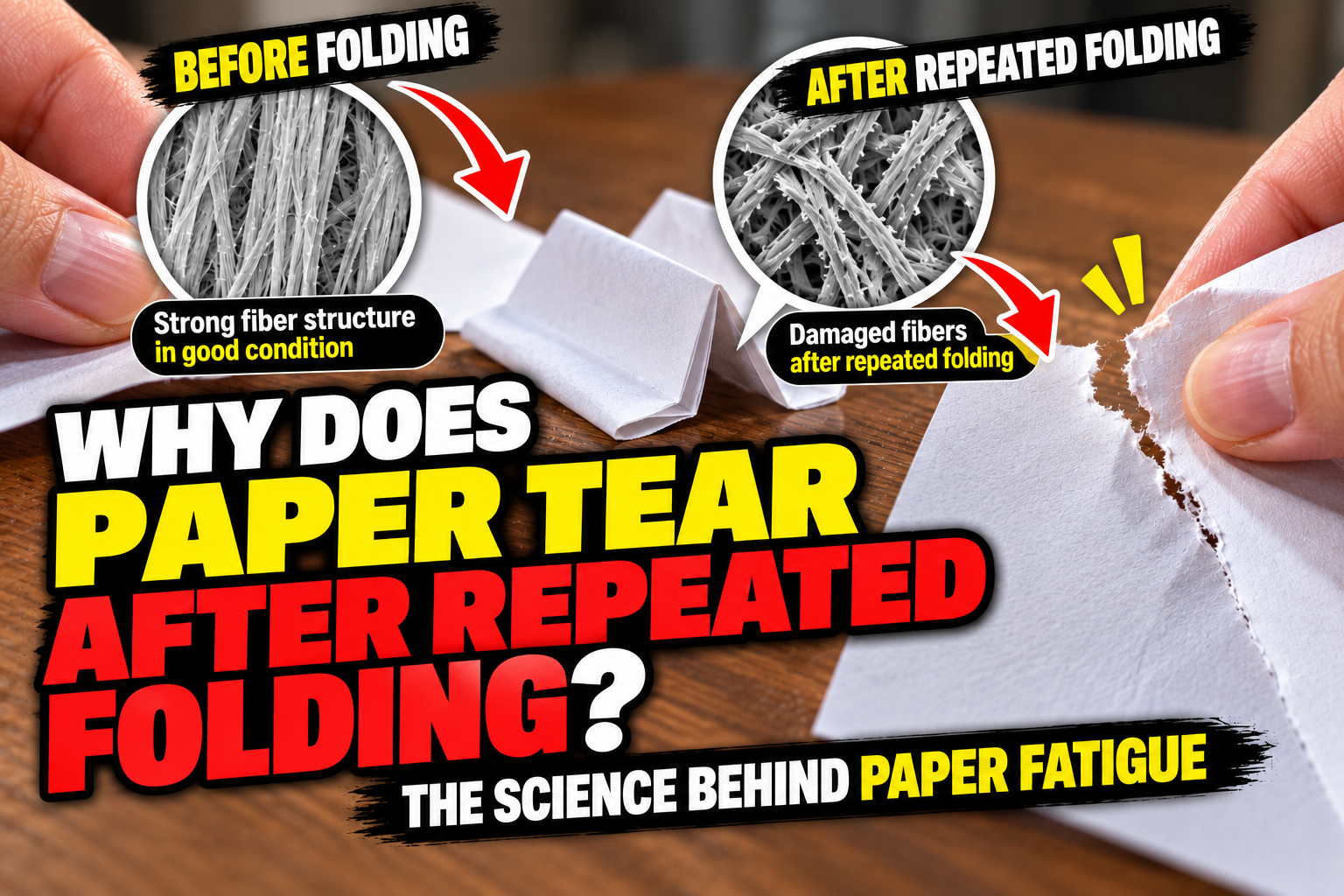
Have you ever folded a piece of paper back and forth several times, only to discover that it suddenly tears along the fold?
At first, the paper may seem perfectly strong. But after repeated folding and unfolding, a visible crease begins to form. Eventually, the same area becomes weaker, and even a small amount of force may be enough to tear it.
This raises an interesting question.
Why does simply folding paper make it easier to tear, even when we haven’t used scissors or any sharp tools?
The answer lies in the microscopic structure of paper and the mechanical damage caused by repeated bending.
Paper is made from countless plant fibers connected in a complex network. When the same area is bent repeatedly, these fibers and the bonds between them experience mechanical stress.
Over time, repeated deformation can weaken the structure.
This process is related to material fatigue, a phenomenon that occurs when repeated loading gradually damages a material.
In this article, we’ll explore why repeated folding weakens paper, why creases remain visible, how different paper products resist folding damage, and what this everyday phenomenon reveals about materials science.
1. What Happens Inside Paper When You Fold It?
When you fold a sheet of paper, the change is more complicated than it appears.
The paper does not simply change shape without experiencing internal forces.
Instead, bending creates different types of deformation across the thickness of the sheet.
The outer surface of the fold stretches, while the inner surface is compressed.
These are known as tensile and compressive strains.
Between these regions is an area where the length changes relatively little during bending.
The sharper the fold, the more concentrated the deformation becomes.
If you gently curve a sheet of paper, the fibers may experience relatively small strains.
However, if you press the fold firmly with your fingernail, the paper is forced into a very tight bend.
This creates high local stresses in a narrow region.
As a result, fibers may shift, bonds between neighboring fibers may separate, and the internal structure may undergo permanent changes.
Therefore, folding paper is not merely a change in appearance.
It is a mechanical process that can alter the material itself.
2. Why Does a White Line Sometimes Appear Along a Fold?
Have you ever folded a dark-colored sheet of paper and noticed a pale or white line along the crease?
This effect is especially noticeable on printed packaging, colored paper, and coated materials.
Several processes can contribute to this appearance.
When paper is folded sharply, the surface and the underlying fiber network may experience significant deformation.
Tiny cracks or gaps can develop in the surface structure.
These changes may affect the way light is scattered and reflected.
On printed or coated paper, the ink or coating layer may also crack.
If the darker surface layer separates or breaks, the lighter paper underneath may become visible.
This can make the fold appear white or noticeably lighter than the surrounding area.
However, not every paper develops a white crease.
The effect depends on the type of paper, the coating, the printing method, and the severity of the fold.
Manufacturers of printed packaging often pay close attention to this issue because visible cracking can reduce the appearance and quality of a finished product.
3. Why Does Repeated Folding Make Paper Weaker?
Folding paper once is different from folding the same area ten or twenty times.
During the first fold, some fibers and bonds may undergo deformation.
When the paper is unfolded and folded again, the same region experiences another cycle of mechanical stress.
As the process continues, damage may accumulate.
Some bonds between fibers can weaken or separate.
Individual fibers may become damaged, and small defects may develop around the crease.
These changes reduce the ability of the affected region to withstand additional forces.
This process is related to fatigue damage.
In materials science, fatigue refers to damage that develops under repeated or cyclic loading.
Metal components, plastic products, and other materials can experience fatigue when they are repeatedly bent or stressed.
Paper can also suffer damage from repeated bending, although its behavior differs from that of metals.
Because paper is a network of fibers, its response depends on fiber properties, bonding, moisture, coatings, and other structural factors.
The important point is that repeated folding concentrates deformation in the same narrow region.
Eventually, that region may become much easier to tear than the surrounding paper.
4. Why Doesn’t a Paper Crease Disappear When You Unfold It?
If you fold a sheet of paper and then open it again, a visible line usually remains.
Even if you press the paper flat with your hands, the crease may still be noticeable.
Why doesn’t the paper simply return to its original shape?
The explanation involves the difference between elastic and permanent deformation.
Elastic deformation occurs when a material changes shape under force but returns toward its original shape after the force is removed.
For example, gently bending a sheet of paper without creating a sharp crease may allow it to recover much of its original shape.
However, a sharp fold can produce permanent deformation.
Fibers may rearrange, bonds may change, and parts of the network may be compressed or damaged.
These changes are not always fully reversible.
In materials science, permanent deformation is often discussed in terms of plastic deformation.
Paper has a complex fiber-based structure, so its response includes more than the simple plastic behavior seen in some other materials.
Nevertheless, the main principle remains the same.
A sharply folded sheet may retain structural changes even after it has been unfolded.
The crease is visible evidence that the paper has experienced localized deformation.
5. Is Thick Paper More Resistant to Folding Damage?
It is tempting to assume that thicker paper must always be stronger.
But thickness alone does not determine how well paper withstands repeated folding.
Thicker paper can require more force to bend sharply.
When a thick sheet is folded around a very small radius, the outer surface may experience substantial tensile strain.
This can lead to surface cracking, especially when the paper has a relatively brittle coating.
Thin paper, on the other hand, is often easier to bend.
However, that does not automatically mean it has greater folding endurance.
The ability to survive repeated folding also depends on fiber length, fiber flexibility, bonding, manufacturing methods, and environmental conditions.
For example, ordinary printer paper, packaging paper, and specialty folding papers are designed for different purposes.
Some papers prioritize smooth printing surfaces.
Others are engineered to tolerate bending, handling, or repeated movement.
Therefore, a thicker sheet is not necessarily better at resisting fatigue damage.
The entire structure of the paper must be considered.
6. Why Can Banknotes Survive Repeated Folding?
Banknotes provide an interesting example of materials designed to withstand frequent handling.
People fold banknotes, place them in wallets, and handle them repeatedly.
Yet many banknotes are significantly more durable under normal circulation than ordinary printer paper.
One reason is that banknotes often use different materials.
Many countries manufacture banknotes using cotton-based substrates rather than ordinary wood-pulp paper.
Cotton fibers can provide properties that are useful for durability under repeated handling.
Some countries also use polymer banknotes.
These are made from specialized plastic-based substrates rather than conventional cellulose paper.
The exact materials and manufacturing processes vary between countries and denominations.
However, banknote design generally considers durability, security, printability, and resistance to everyday wear.
This does not mean banknotes are indestructible.
They can still become damaged after extensive use, repeated folding, or exposure to harsh conditions.
The important lesson is that material selection and manufacturing technology strongly influence how a product performs under repeated mechanical stress.
7. How Do Books and Paper Packaging Resist Folding Damage?
Books and packaging products are frequently bent, opened, or folded during normal use.
Because of this, their design must account for mechanical deformation.
A book page needs to turn smoothly without excessive damage.
Packaging materials often need to fold along predetermined lines without producing unwanted cracks.
For thick paperboard, manufacturers may use a process called creasing.
Creasing creates a controlled line or region where the material is intended to fold.
Instead of forcing a thick sheet to bend unpredictably, the crease helps guide the fold to a specific location.
When properly designed, creasing can improve folding quality and reduce unwanted surface cracking.
However, the best creasing method depends on the material.
Coated paperboard, uncoated paperboard, and different packaging structures may require different processing conditions.
This is why many commercial packages have neat, well-defined folding lines.
Their appearance is not simply the result of folding carefully by hand.
It often reflects deliberate engineering during manufacturing.
8. Does Humidity Affect How Paper Folds?
Paper is sensitive to moisture in the surrounding environment.
Its cellulose fibers can absorb and release water vapor as humidity changes.
This affects the mechanical behavior of the sheet.
Under very dry conditions, some papers may become relatively stiff or more vulnerable to certain types of cracking.
When moisture content increases, the fibers and their interactions may behave differently.
Some papers may become more flexible.
However, excessive moisture can also reduce certain types of strength.
Therefore, higher humidity does not automatically mean better folding endurance.
The relationship depends on the type of paper, its moisture content, and the mechanical property being measured.
This is one reason temperature and humidity are important in paper manufacturing, printing, storage, and conservation.
Stable environmental conditions can help reduce unwanted changes in paper properties.
For valuable documents and books, avoiding extreme or rapidly changing conditions is generally preferable.
9. A Simple Experiment: Does Repeated Folding Weaken Paper?
You can explore the effects of repeated folding with a simple experiment at home.
You will need several sheets of ordinary printer paper, scissors, a ruler, and a pencil.
Step 1: Prepare Equal Paper Strips
Cut several strips of the same length and width from the same type of paper.
Try to keep their orientation consistent.
Step 2: Create Different Folding Conditions
Leave the first strip unfolded.
Fold the second strip once at its center, then unfold it.
Fold the third strip back and forth five times along the same line.
Fold the fourth strip back and forth ten times along the same line.
Try to keep the fold location and folding method consistent.
Step 3: Examine the Creases
Compare the appearance of the strips.
Look for differences in crease visibility, surface texture, and any signs of fiber damage.
Does the strip folded ten times show a more pronounced crease?
Can you see small cracks or areas where the surface looks lighter?
Step 4: Compare Tearing Behavior
Carefully try tearing the strips at the crease.
Notice whether some strips appear easier to tear than others.
However, remember that the force applied by hand is difficult to control precisely.
This means the experiment cannot reliably measure the exact percentage reduction in strength.
Step 5: Repeat the Experiment
Repeat the process with additional samples.
Different types of paper may produce different results.
The goal is to observe how repeated deformation affects the structure and behavior of paper.
This experiment demonstrates how small amounts of damage can accumulate when a material experiences repeated mechanical stress.
10. How Can You Reduce Folding Damage?
Although paper naturally experiences wear during use, several simple practices can help reduce unnecessary damage.
First, avoid repeatedly folding important documents along the same line.
Repeated bending can concentrate stress and gradually weaken the affected area.
Second, use bookmarks instead of folding the corners of book pages.
This helps preserve the condition of the pages, especially in books intended for long-term use.
Third, avoid forcing thick paperboard into extremely sharp folds without suitable preparation.
For crafts or packaging projects, an appropriate scoring or creasing technique may improve the result.
Fourth, store important paper materials in stable environmental conditions.
Excessive dryness, high humidity, and rapid environmental changes may affect their mechanical properties.
Finally, minimize unnecessary handling of fragile or historically valuable documents.
For irreplaceable materials, professional conservation advice may be appropriate.
These precautions cannot prevent all forms of aging or wear, but they can reduce avoidable mechanical damage.
Conclusion: A Paper Crease Can Reveal Hidden Structural Damage
Paper becomes easier to tear after repeated folding because the same narrow region experiences mechanical deformation again and again.
When paper bends, the outer surface stretches while the inner surface is compressed.
Sharp folding can produce permanent changes in the fiber network.
As folding cycles continue, bonds between fibers may weaken, individual fibers may become damaged, and small defects can accumulate.
Eventually, the crease may become a mechanically vulnerable region.
This explains why a sheet of paper can tear along a repeatedly folded line even when the surrounding material remains relatively strong.
The same principles help explain why different paper products have different folding endurance and why specialized materials are used for banknotes, books, and packaging.
A crease may look like a simple line on the surface.
But at a microscopic level, it can represent a history of mechanical stress and structural change.
The next time you fold a sheet of paper, take a closer look at the crease.
That small mark reveals a fascinating connection between everyday objects and the science of materials.
Insight 50’s Paper Science series explores the hidden scientific principles behind everyday paper products through accessible explanations, practical examples, and simple experiments.