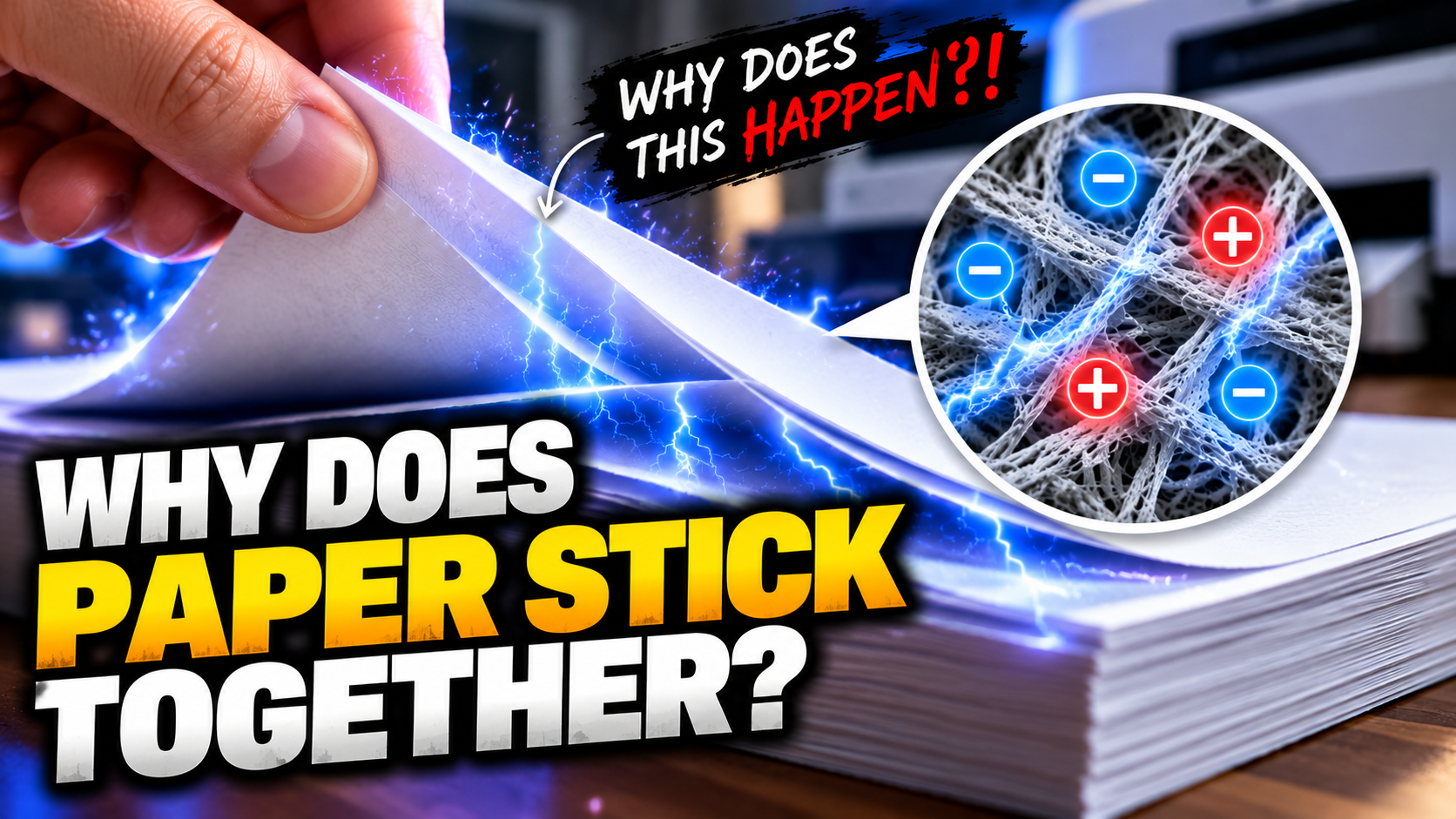
Have you ever tried to pick up a single sheet of printer paper, only to find that several sheets were sticking together?
Or perhaps you’ve experienced a printer pulling in two or three sheets at once, causing a paper jam.
These problems can be especially noticeable during dry winter months.
At first, this might seem strange.
Paper is not a metal, and it does not conduct electricity nearly as easily as materials such as copper or aluminum.
So how can ordinary paper accumulate electric charges?
And why does the same stack of paper sometimes separate easily in humid conditions but cling together in dry air?
The answer involves static electricity, the molecular structure of paper, surface interactions, and the influence of moisture.
Static electricity is not limited to the small shocks we occasionally feel when touching a metal doorknob.
It also plays an important role in printing technology, industrial paper processing, packaging, and material handling.
In this article, we will examine how static electricity develops on paper, why humidity influences charge accumulation, and how these effects are controlled in modern printing and manufacturing systems.
1. What Is Static Electricity?
Static electricity refers to phenomena associated with an imbalance or accumulation of electric charge.
To understand it, we first need to consider the structure of matter.
Atoms contain positively charged protons and negatively charged electrons.
In an electrically neutral object, the total positive and negative charges are balanced.
However, when electric charges move between materials or become separated, an imbalance can develop.
This imbalance may cause an object to become electrically charged.
One familiar example involves rubbing a plastic ruler against a piece of fabric.
Afterward, the ruler may attract small pieces of paper.
This behavior is related to a phenomenon known as contact electrification, often called triboelectric charging.
Despite its association with friction, contact electrification does not always require vigorous rubbing.
Simply bringing certain materials into contact and then separating them can produce charge transfer or charge separation.
The exact microscopic mechanisms depend on the materials and their surface conditions.
Scientists continue to investigate the roles of electrons, ions, and material transfer in different contact-electrification systems.
Therefore, static electricity should not be understood as a phenomenon caused exclusively by friction.
It is more accurately associated with the creation, separation, and persistence of electric charges.
2. Why Can Paper Generate Static Electricity?
Paper is primarily made from cellulose fibers.
Cellulose is a natural polymer found in the cell walls of plants.
Unlike metals, ordinary paper generally has relatively high electrical resistance, especially when it is dry.
This means electric charges cannot move through it as freely as they can through a good conductor.
However, being a poor electrical conductor does not mean that a material cannot become electrically charged.
In fact, under certain conditions, high electrical resistance can allow accumulated charges to remain on a surface for a relatively long time.
When paper comes into contact with other materials, such as plastic, rubber rollers, or another sheet of paper, charge separation may occur.
As the surfaces move apart, some electric charge can remain.
This is particularly relevant in printing equipment, where paper repeatedly contacts and separates from rollers and other components.
However, the electrical properties of paper are not fixed.
They depend on several factors, including moisture content, surface coatings, additives, temperature, and relative humidity.
Different paper products can therefore behave differently under the same environmental conditions.
Understanding paper as a complex fibrous material is essential for explaining its electrical behavior.
3. Why Do Sheets of Paper Stick Together?
When sheets of paper become electrically charged, electrostatic forces may influence how they interact.
Electric charges exert forces on one another.
Charges with opposite signs attract, while charges with the same sign repel.
A charged object can also attract an electrically neutral object by causing a redistribution or polarization of charge within it.
This explains why a charged plastic ruler may attract small paper fragments even when those fragments initially have no overall electric charge.
Similar interactions can occur between sheets of paper.
If the electrostatic attraction between neighboring sheets becomes sufficiently strong, separating them may become more difficult.
However, static electricity is not the only reason paper can stick together.
Surface roughness, mechanical pressure, friction, moisture, and the shape of the sheets can also influence adhesion.
For example, excessive humidity may cause paper surfaces to interact through moisture-related adhesion.
Therefore, paper sticking together does not automatically prove that static electricity is the cause.
The actual behavior often results from several physical factors acting simultaneously.
4. Why Is Static Electricity More Noticeable in Dry Weather?
Static electricity is often associated with cold, dry winter conditions.
Many people notice more frequent static shocks when removing clothing or touching metal objects during this season.
Paper can show a similar sensitivity to environmental conditions.
One important reason is the relationship between humidity and electrical charge dissipation.
Cellulose is hygroscopic, meaning it can absorb moisture from the surrounding environment.
As relative humidity changes, the moisture content of paper can also change.
This affects its electrical properties.
Under many conditions, dry paper has higher electrical resistance.
As a result, charges that accumulate on its surface may dissipate more slowly.
When paper contains more moisture, pathways for electrical charge movement may become more effective.
This can allow accumulated charges to dissipate more rapidly.
However, humidity does not eliminate static electricity under every condition.
Its influence depends on the paper’s composition, surface treatment, temperature, and charging mechanism.
Humidity is therefore an important factor in static electricity control, but it is not the only one.
5. How Does Humidity Affect the Electrical Resistance of Paper?
Electrical resistance describes how strongly a material opposes the flow of electric current.
Dry paper generally has high electrical resistance.
However, this resistance can change significantly as the paper absorbs moisture.
Cellulose fibers contain chemical groups that interact with water molecules.
When environmental humidity increases, the amount and distribution of water associated with the fibers may change.
These changes can influence how electrical charges move along the surface or through the paper structure.
Under suitable conditions, increasing moisture content can reduce electrical resistance.
This allows accumulated charges to dissipate more easily.
Conversely, very dry conditions may allow electrostatic charges to persist.
However, the relationship between humidity and electrical resistance is not identical for every paper product.
Coatings, fillers, manufacturing additives, fiber composition, and temperature can all influence the result.
This is one reason industrial paper processing requires careful environmental control.
Manufacturers must consider both the moisture content of the paper and the surrounding operating conditions.
6. Can Static Electricity Cause Printer Paper Jams?
Printers sometimes pull multiple sheets into the paper path at once.
This problem is commonly called multiple-sheet feeding or double feeding.
Static electricity can contribute to this behavior under certain conditions.
If neighboring sheets are electrostatically attracted to one another, the feeding mechanism may have difficulty separating them.
As a result, more than one sheet may enter the printer.
However, static electricity is only one possible cause.
Other common factors include worn feed rollers, unsuitable paper, excessive moisture, curled sheets, and mechanical problems in the feeding system.
For this reason, it is not accurate to assume that every paper jam is caused by electrostatic charging.
If a printer repeatedly feeds multiple sheets, several conditions should be checked.
The paper should be suitable for the device.
It should be stored according to the manufacturer’s recommendations.
The sheets should not be excessively curled, damaged, or stuck together.
The printer’s feeding components should also be maintained according to the manufacturer’s instructions.
A reliable solution depends on identifying the actual cause rather than focusing on static electricity alone.
7. How Do Laser Printers Use Electricity to Print?
Static electricity can cause difficulties in paper handling.
Surprisingly, controlled electrical forces are also essential to many modern printing technologies.
Laser printers and photocopiers commonly use an electrophotographic printing process.
This technology relies on carefully controlled electrical charges to position toner particles.
The process begins with a photoconductive surface.
An electrical charge is established on this surface.
A laser or another light source then changes the charge distribution in selected areas.
This creates an electrostatic pattern corresponding to the image or text being printed.
Charged toner particles interact with the pattern and are deposited in the intended locations.
The toner image is then transferred to paper.
Finally, heat and pressure are typically used to fuse the toner to the paper surface.
This process demonstrates an important principle.
Static electricity is not always something that needs to be eliminated.
When carefully controlled, electrical charge becomes a useful tool for transferring images and text.
The challenge is to maintain the charges needed for printing while preventing unwanted electrostatic effects elsewhere in the equipment.
8. Why Is Static Electricity a Problem in Paper Manufacturing?
Industrial paper production and printing involve large quantities of material moving at high speeds.
Sheets and paper webs repeatedly contact rollers, belts, guides, and other surfaces.
These interactions can produce contact electrification.
As electric charges accumulate, unwanted electrostatic forces may affect the manufacturing process.
For example, charged paper may stick to nearby surfaces or become difficult to separate.
Electrostatic attraction may also encourage dust and small particles to adhere to materials.
In some operations, uncontrolled charging can interfere with sheet alignment, stacking, or transport.
Electrostatic discharge may also require attention as part of equipment and workplace safety management, depending on the operating environment.
For these reasons, industrial facilities use various methods to manage electrical charge.
These may include humidity control, ionizing equipment, grounding of conductive machine components, and adjustments to material surfaces.
However, no single method works equally well for every production system.
The appropriate approach depends on the machinery, materials, operating speed, and environmental conditions.
9. How Do Industrial Static Eliminators Work?
Some industrial static-control systems use ionization to reduce unwanted electric charges.
An ionizer generates or supplies positive and negative ions in the surrounding air.
These ions can interact with charged surfaces.
For example, if a surface has accumulated excess negative charge, positive ions may help neutralize that imbalance.
Similarly, negative ions may help reduce excess positive charge.
This approach can be useful for insulating materials, where charges cannot easily travel through the material to an electrical ground.
Some devices combine ionization with airflow to carry ions toward the target surface.
However, their effectiveness depends on several factors.
These include the distance to the material, airflow conditions, the surrounding environment, and the electrical properties of the surface.
Ionization is not a universal solution to every electrostatic problem.
In many industrial settings, it is used alongside other measures, such as humidity management and equipment maintenance.
10. How Can You Reduce Static Electricity in Paper at Home?
You do not need industrial equipment to reduce common paper-handling problems.
Several practical habits may help.
Store Paper Under Suitable Conditions
Avoid keeping printer paper in extremely dry or excessively humid environments.
Paper absorbs and releases moisture depending on its surroundings.
Large changes in moisture content can affect its physical and electrical properties.
Follow the storage recommendations provided by the paper manufacturer whenever possible.
Keep Unused Paper Protected
Keeping unused paper in its original packaging until needed can help reduce exposure to changing environmental conditions.
This is especially useful when storing printer paper for extended periods.
Check the Condition of the Sheets
Before loading paper into a printer, inspect it for curling, damage, or sheets that are stuck together.
Poorly stored paper may cause feeding problems even when static electricity is not the main issue.
Maintain Printer Components
Feed rollers and separation mechanisms can become worn or contaminated over time.
Follow the printer manufacturer’s maintenance instructions.
Avoid Unsafe Electrical Modifications
Do not attempt to modify electrical equipment or create improvised discharge systems to remove static electricity.
Industrial charge-control equipment should be selected and installed according to appropriate safety requirements.
For most home users, proper paper storage and routine printer maintenance are more practical starting points.
11. A Simple Experiment: Can Static Electricity Attract Paper?
You can observe electrostatic attraction using a few ordinary household materials.
You will need a plastic ruler or comb, a dry cloth, and several small pieces of paper.
Step 1: Prepare the Paper
Cut a sheet of ordinary paper into several small, lightweight pieces.
Place them on a dry tabletop.
Step 2: Charge the Plastic Object
Rub the plastic ruler or comb with a dry cloth several times.
Depending on the materials, this contact and separation process may leave the plastic electrically charged.
Step 3: Bring the Ruler Near the Paper
Slowly move the ruler toward the paper pieces without touching them at first.
Under suitable conditions, some pieces may move toward the ruler or jump up and attach to it.
Step 4: Observe the Results
The charged plastic creates an electric field.
This field can influence the distribution of electric charge within nearby neutral paper pieces.
The resulting electrostatic attraction may be strong enough to move the lightweight paper.
Step 5: Compare Different Conditions
Repeat the experiment on different days or under different humidity conditions.
You may notice changes in the strength or persistence of the attraction.
However, humidity is not the only variable affecting the experiment.
The plastic material, cloth type, rubbing technique, and paper size also matter.
Therefore, the experiment demonstrates electrostatic attraction but does not provide a precise measurement of electric charge.
It is a simple way to observe an important physical phenomenon using everyday materials.
12. Why Does Research on Paper Static Electricity Matter?
The study of static electricity in paper connects several scientific and engineering disciplines.
It involves materials science because paper is a complex structure made from cellulose fibers and other components.
It involves physics because electric charges and electrostatic forces influence how materials interact.
It also involves engineering because industrial equipment must control these effects during manufacturing and printing.
In paper production, understanding electrostatic behavior can help improve material transport and processing consistency.
In printing, controlled electrical charges are essential for electrophotographic image formation.
In packaging, electrostatic interactions can influence how sheets and films separate or adhere.
Research into paper-based electronic materials may also require an understanding of surface properties and electrical behavior.
These examples show that paper is more than a simple surface for writing.
It is a functional material whose behavior depends on its structure, chemistry, moisture content, and surrounding environment.
Understanding its electrical properties can therefore contribute to better manufacturing processes and new material technologies.
Conclusion: Why Paper Static Electricity Depends on Both Material and Environment
Static electricity in paper develops when electric charges are transferred, separated, or accumulated during interactions between materials.
Although paper is generally a poor electrical conductor, it can still become electrically charged.
In fact, its relatively high electrical resistance under dry conditions can allow charges to remain for extended periods.
Humidity plays an important role because moisture can influence electrical resistance and charge dissipation.
Under many conditions, dry paper retains electrostatic charge more readily than paper containing more moisture.
These effects may contribute to sheets sticking together or difficulties in printer feeding systems.
However, paper adhesion and feeding problems can also have mechanical or moisture-related causes.
Static electricity is not always undesirable.
Laser printers and photocopiers demonstrate how carefully controlled electrical forces can be used to produce printed images.
Ultimately, the behavior of paper depends on the interaction between material properties, surface conditions, electric charges, and environmental factors.
The next time several sheets of paper cling together, consider what might be happening at their surfaces.
A seemingly ordinary stack of paper can reveal fascinating connections between electricity, chemistry, and materials science.
Insight 50’s Paper Science series explores the physical and chemical properties of everyday paper products through accessible explanations grounded in scientific principles.