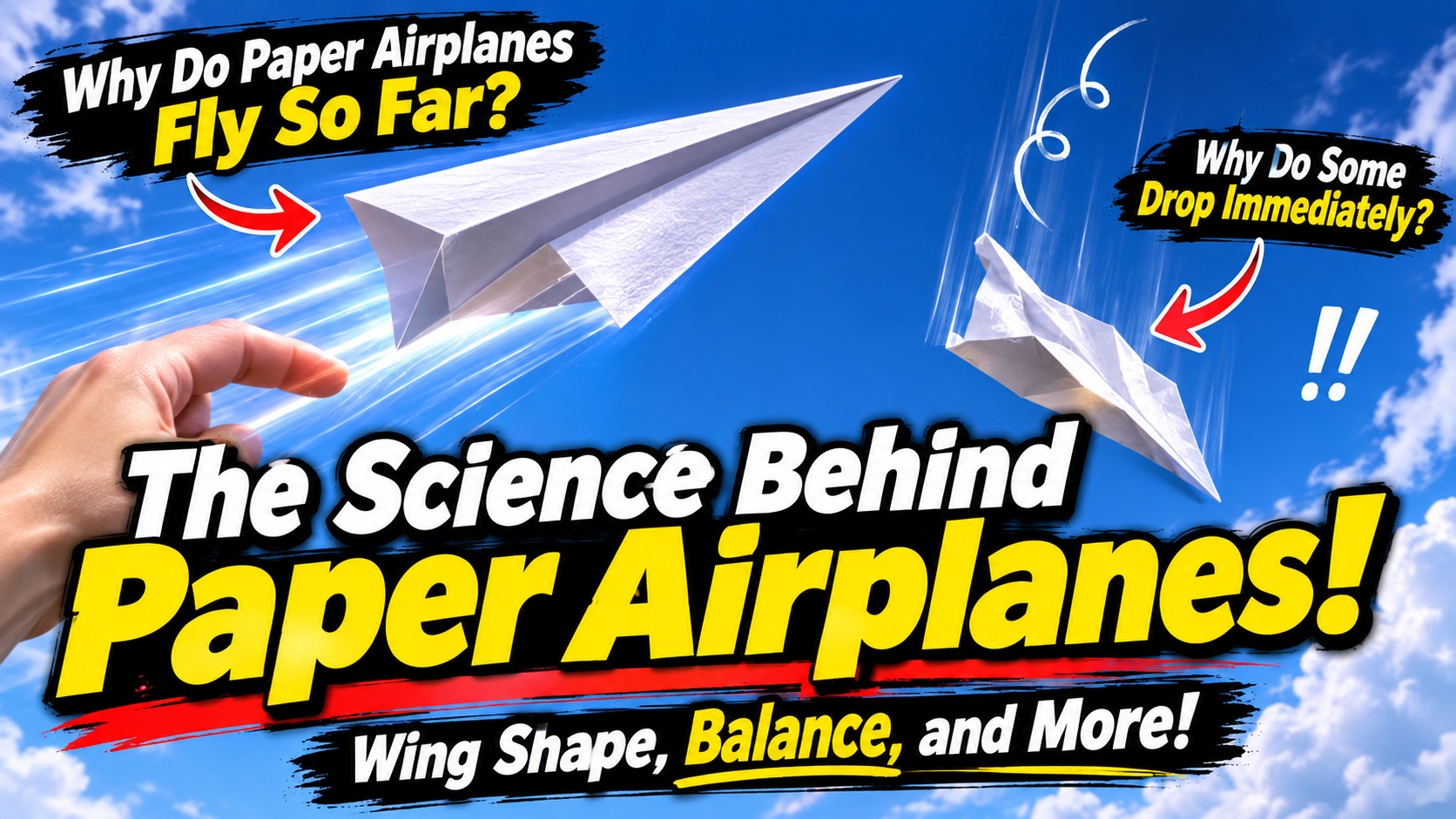
Have you ever folded a paper airplane, thrown it across a room, and watched it glide surprisingly far?
Now imagine folding another airplane from the exact same type of paper, only to see it fall to the floor almost immediately.
Both airplanes are made of paper. Neither has an engine. And yet their flight performances can be completely different.
Why does this happen?
Does throwing a paper airplane harder always make it fly farther? Do bigger wings guarantee a longer flight? Does making the nose heavier improve its performance?
The answers are more complicated than they might seem.
Although paper airplanes are simple toys, they follow many of the same physical principles that govern real aircraft.
Gravity, lift, drag, balance, and aerodynamic stability all influence how a paper airplane moves through the air.
Even small changes in wing shape, folding accuracy, or weight distribution can significantly affect its flight path.
In this article, we will explore the science behind paper airplanes, discover why some designs travel farther than others, and learn how to conduct simple experiments to improve their performance.
1. How Can a Paper Airplane Fly Without an Engine?
Real airplanes use engines or other propulsion systems to generate thrust.
Paper airplanes have no engines.
So how can they move through the air?
The answer begins with the initial speed provided when you throw them.
When you launch a paper airplane, your hand gives it forward velocity.
As the airplane moves through the surrounding air, aerodynamic forces begin acting on its wings and body.
Two important forces are lift and drag.
Lift is the aerodynamic force that acts perpendicular to the direction of the airflow relative to the airplane.
Drag acts in a direction that opposes the airplane’s motion through the air.
Gravity also continuously pulls the airplane toward Earth.
After leaving your hand, a paper airplane generally performs an unpowered gliding flight.
It gradually loses energy because of aerodynamic drag and typically loses altitude as it travels.
However, the presence of gravity does not mean the airplane must fall straight down.
The aerodynamic forces generated during forward motion can allow it to follow a gradual descending path.
This is why a well-designed paper airplane can travel a considerable horizontal distance before reaching the ground.
2. What Do the Wings of a Paper Airplane Actually Do?
The wings are among the most important parts of a paper airplane.
They are not simply decorative pieces of folded paper.
Their shape, area, and orientation influence the airflow around the airplane.
When a wing moves through air, it changes the motion of the surrounding air and experiences differences in pressure across its surfaces.
These aerodynamic interactions can generate lift.
Lift helps determine the airplane’s flight path and how quickly it loses altitude.
However, the amount of lift depends on several factors.
These include airspeed, wing area, air density, wing shape, and angle of attack.
The angle of attack is the angle between the wing’s reference line and the oncoming airflow.
If the angle of attack is too small, the wing may not generate enough lift for the desired flight condition.
If it becomes too large, airflow separation and increased drag can reduce performance.
Therefore, having large wings is not enough.
The wings must also interact with the airflow in a suitable way.
This is why two paper airplanes with similar wing areas may behave very differently when thrown.
3. Do Bigger Wings Make Paper Airplanes Fly Farther?
At first glance, bigger wings seem like an obvious advantage.
After all, larger wings can generate more lift under otherwise similar conditions.
But there is an important trade-off.
Increasing wing area also changes aerodynamic drag and the overall behavior of the airplane.
A design with broad wings may be suitable for relatively slow gliding flight.
It may remain airborne longer under favorable conditions.
However, larger wings do not automatically guarantee a greater horizontal distance.
A narrow-wing design may perform well when launched at a higher speed, depending on its stability and aerodynamic efficiency.
The difference becomes clearer when we consider two separate goals.
One goal is to remain in the air for as long as possible.
The other is to travel the greatest horizontal distance.
These goals are related, but they are not identical.
A paper airplane optimized for a long flight time may not be the same design that achieves the greatest distance.
The best wing configuration depends on the intended flight conditions and the overall design.
4. Why Is the Center of Gravity So Important?
When folding a paper airplane, you may notice that many designs have several layers of paper near the nose.
These folds make the front of the airplane relatively heavy.
This changes the position of its center of gravity.
The center of gravity is the point through which the airplane’s weight can be considered to act.
Its location plays an important role in flight balance and stability.
If the center of gravity is too far toward the rear for a particular design, the airplane may become unstable.
It may pitch upward, oscillate, or behave unpredictably.
If the center of gravity is too far forward, the airplane may have a stronger tendency to pitch downward.
However, a forward center of gravity is not always bad.
The correct position depends on the airplane’s wing geometry and overall aerodynamic characteristics.
A well-balanced paper airplane needs a suitable relationship between its center of gravity and the aerodynamic forces acting on it.
This is one reason folding accuracy matters.
Even small differences in the nose or wing structure can change the airplane’s balance.
5. Why Do Some Paper Airplanes Rise and Then Suddenly Fall?
Have you ever thrown a paper airplane and watched it climb sharply before dropping toward the ground?
This is a common flight pattern.
Several factors can cause it.
One possibility is that the airplane was launched at an excessively steep upward angle.
As it climbs, gravity reduces its speed.
When the airplane slows down, the aerodynamic forces acting on its wings change.
If the angle of attack becomes too high, airflow may separate from the wing in a way that causes a significant loss of lift.
This phenomenon is known as an aerodynamic stall.
A stall does not mean an engine has stopped working.
It is an aerodynamic condition related primarily to the angle of attack.
Paper airplanes can experience stall-like behavior under certain conditions.
However, not every sudden downward movement is caused by a stall.
Poor balance, unstable pitch behavior, or an unsuitable launch angle can also contribute.
The important lesson is that a successful launch requires more than simply throwing the airplane upward.
The airplane must maintain a suitable combination of speed, attitude, and stability.
6. Why Does a Paper Airplane Turn Left or Right?
Sometimes a paper airplane curves sharply to one side even when you throw it straight ahead.
One possible explanation is asymmetry.
Because paper airplanes are folded by hand, their left and right wings may not be perfectly identical.
One wing may be slightly larger, more curved, or positioned at a different angle.
These differences can produce unequal aerodynamic forces.
As a result, the airplane may roll, turn, or drift toward one side.
Uneven weight distribution can also affect the flight path.
For example, if one side contains an extra fold or is more tightly compressed, the airplane may not be perfectly balanced.
Environmental conditions matter as well.
Air currents from fans, air conditioners, open windows, or ventilation systems can change the flight path.
This is why testing paper airplanes in a calm indoor environment can produce more consistent results.
If your airplane repeatedly turns in one direction, inspect the symmetry of its wings before making major design changes.
7. Does Throwing a Paper Airplane Harder Make It Fly Farther?
A powerful throw gives a paper airplane more initial speed and kinetic energy.
That can be useful.
However, throwing harder does not always produce a longer flight.
Aerodynamic drag generally increases as airspeed increases.
At higher speeds, a paper airplane may experience stronger aerodynamic forces.
If its wings are not sufficiently stiff, they may bend or deform.
This can change the intended aerodynamic shape and make the airplane less stable.
Launch angle also matters.
A paper airplane thrown too steeply upward may lose speed quickly and then descend sharply.
An airplane thrown too far downward may hit the ground before covering much horizontal distance.
Different designs respond differently to launch speed and angle.
Some narrow-wing designs may tolerate faster launches better than broad-wing gliders.
However, there is no single ideal throwing speed for every paper airplane.
The most effective approach is to test different launch conditions while keeping the airplane’s design unchanged.
This helps identify the speed and angle that work best for that particular model.
8. Does the Type of Paper Affect Flight Distance?
Yes. The type of paper can influence how a paper airplane flies.
Paper varies in thickness, mass, stiffness, and surface properties.
These characteristics affect the airplane’s overall weight and its ability to maintain its shape during flight.
Very thin paper is lightweight, but it may bend or flutter under aerodynamic loads.
If the wings deform too much, the airplane may lose the shape needed for stable flight.
Thicker paper may hold its shape more effectively.
However, it also tends to increase the airplane’s mass.
For the same wing area, a heavier airplane generally requires different flight conditions to generate enough lift.
This relationship is connected to wing loading, which is the airplane’s weight divided by its wing area.
Higher wing loading often corresponds to higher characteristic flight speeds, although actual performance depends on the entire design.
Ordinary printer paper is popular for paper airplanes because it offers a practical balance between foldability, stiffness, and weight.
But it is not necessarily the best material for every design.
A lightweight glider and a fast, narrow-wing airplane may benefit from different paper characteristics.
9. What’s the Difference Between Flying Far and Staying Airborne Longer?
Paper airplane competitions often measure two different achievements.
The first is maximum flight distance.
The second is maximum time in the air.
These are distinct performance goals.
For distance, the objective is to maximize horizontal travel before the airplane reaches the ground.
For flight duration, the objective is to remain airborne for as long as possible.
Both depend on aerodynamics, stability, and launch conditions.
However, the ideal design choices may differ.
A broad-wing glider may be suitable for slow flight and a longer descent.
A narrow-wing design may be better suited to a faster launch, depending on its aerodynamic efficiency.
Another important concept is glide ratio.
Glide ratio describes the horizontal distance traveled relative to the altitude lost during a glide.
Under suitable conditions, a higher glide ratio allows an aircraft to travel farther horizontally for a given loss of altitude.
However, maximum glide ratio and minimum descent rate are not necessarily achieved at the same speed.
This helps explain why the airplane that travels farthest is not always the one that remains airborne the longest.
The best design depends on what you want the airplane to accomplish.
10. A Simple Experiment: Which Paper Airplane Flies Farther?
You can investigate the relationship between airplane design and flight performance using a simple experiment.
You will need several sheets of identical printer paper, a measuring tape, a notebook, and a safe indoor space.
Step 1: Build Two Different Designs
Use the same type and size of paper for both airplanes.
Make one airplane with relatively narrow wings.
Make another airplane with relatively broad wings.
Try to fold each design as symmetrically as possible.
Step 2: Choose a Testing Area
Find an indoor location with enough open space.
Avoid fans, strong ventilation, and other sources of moving air when possible.
Use the same starting position for every throw.
Step 3: Perform Repeated Flights
Throw each airplane several times.
Try to use a similar launch angle and effort for each attempt.
Measure the horizontal distance traveled.
If possible, record the flight duration as well.
Step 4: Record the Results
Create a simple table with the airplane design, flight distance, and flight time.
For example:
| Trial | Narrow-Wing Airplane | Broad-Wing Airplane |
|---|---|---|
| 1 | Record distance | Record distance |
| 2 | Record distance | Record distance |
| 3 | Record distance | Record distance |
| 4 | Record distance | Record distance |
| 5 | Record distance | Record distance |
After completing the trials, calculate the average distance for each design.
Step 5: Interpret the Results
Compare the average flight distances.
Did one airplane consistently travel farther?
Did the other remain in the air longer?
Remember that human throws are not perfectly consistent.
Small differences in launch speed, angle, and release position can affect the results.
Therefore, the experiment cannot prove that wing shape alone caused every observed difference.
For a more controlled investigation, use the same airplane and change only one feature at a time.
Repeating each test helps reduce the influence of random variation.
11. How Can You Make a Paper Airplane Fly More Consistently?
Improving a paper airplane does not necessarily require a complicated design.
Small adjustments can make a noticeable difference.
Start by checking wing symmetry.
Both wings should be as similar as possible in size and angle.
Next, examine the nose and overall balance.
If the airplane repeatedly dives or pitches upward, its center of gravity and aerodynamic configuration may need adjustment.
Make sure the wings are not excessively bent or twisted.
A paper airplane that changes shape during flight may behave unpredictably.
You can also experiment with small adjustments to the rear edges of the wings.
These adjustments may change the airplane’s pitching behavior and flight path.
However, large changes can increase drag or create instability.
Begin with very small adjustments and observe the results.
Most importantly, change one variable at a time.
If you change the wing angle, nose weight, and launch speed simultaneously, it becomes difficult to identify which change affected the flight.
Careful experimentation is often more useful than simply making random modifications.
12. What Can Paper Airplanes Teach Us About Real Aviation?
Paper airplanes are much simpler than modern passenger jets.
They do not have engines, electronic flight controls, or sophisticated aerodynamic surfaces.
Nevertheless, they demonstrate several fundamental ideas used in aviation.
They show how lift and drag influence motion through air.
They demonstrate why center of gravity and stability matter.
They reveal the importance of wing geometry and structural stiffness.
They also illustrate the relationship between initial speed, flight path, and energy loss.
Of course, paper airplanes and full-sized aircraft operate under different conditions.
Their size, speed, construction materials, and aerodynamic behavior are not identical.
Therefore, a design that works well for a paper airplane cannot simply be scaled up into a real aircraft.
Still, the basic physics provides a useful introduction to flight.
A single sheet of paper can become a small laboratory for exploring aerodynamics.
Conclusion: The Secret to a Great Paper Airplane Is Balance
Paper airplanes may look simple, but their flight behavior is governed by a complex interaction of physical forces.
When you throw a paper airplane, it receives initial speed.
As it travels through the air, lift, drag, and gravity influence its motion.
The shape and area of the wings affect aerodynamic performance.
The center of gravity influences balance and stability.
Paper stiffness, folding accuracy, and launch conditions also play important roles.
This is why two paper airplanes made from identical sheets can produce dramatically different flight results.
It also explains why the best design for maximum distance may not be the best design for maximum flight duration.
There is no universal folding pattern that guarantees the longest flight in every situation.
Instead, successful paper airplane design involves understanding the relationship between structure, balance, and airflow.
The next time you fold a paper airplane, try experimenting with one small change.
Adjust the wings, examine the balance, or change the launch angle.
Then observe how the flight changes.
With nothing more than a sheet of paper, you can begin exploring the same fundamental forces that help real aircraft fly.
Insight 50’s Paper Science series explores the fascinating science behind everyday paper products through clear explanations, practical examples, and simple experiments.