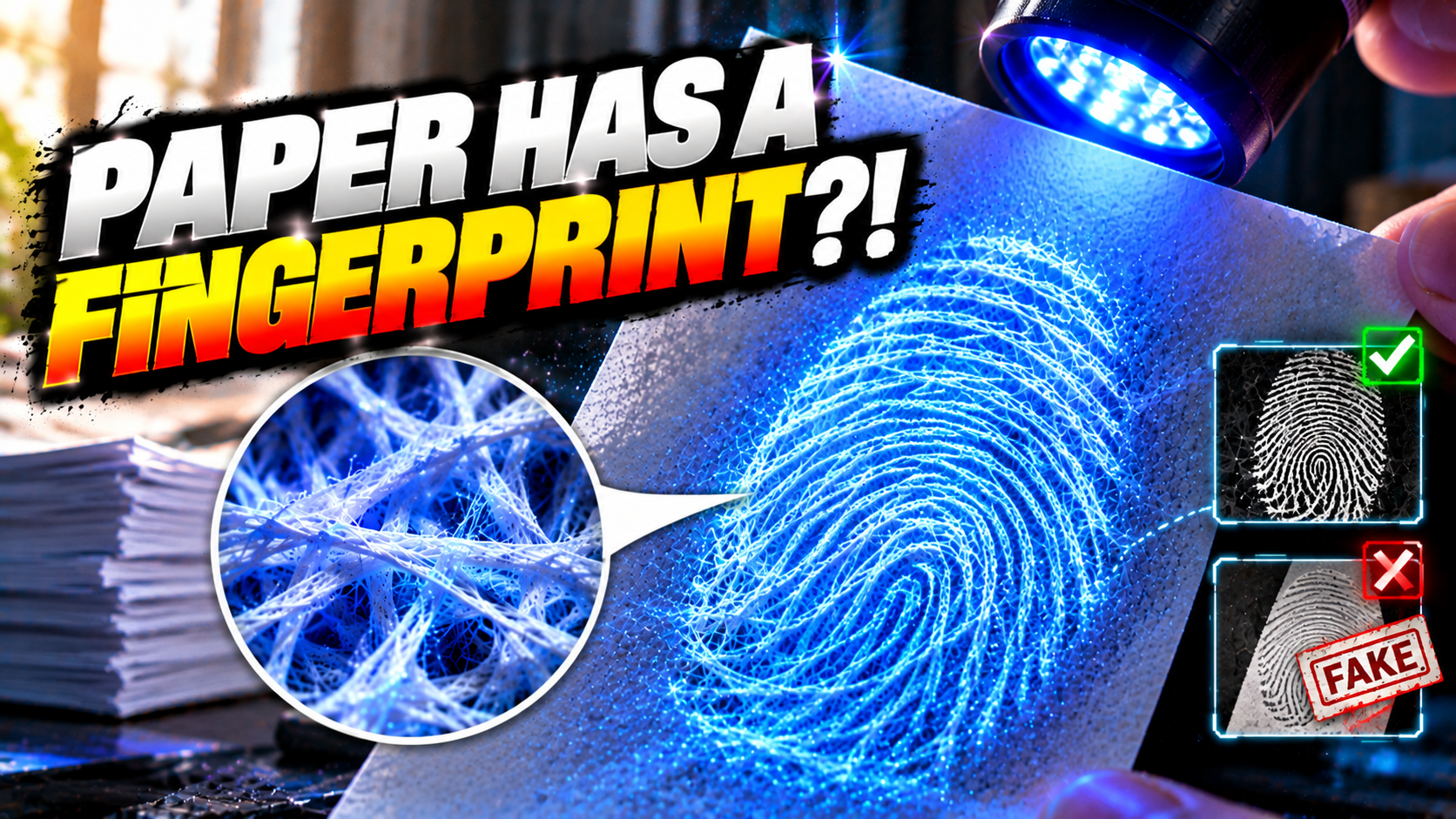
Imagine placing two identical-looking sheets of printer paper side by side.
Both sheets were manufactured by the same company, using the same materials and production equipment.
They have the same color, thickness, and texture.
To the human eye, they appear almost indistinguishable.
But under magnification, a surprising difference emerges.
The cellulose fibers inside each sheet are arranged in slightly different patterns.
Individual fibers overlap at different points, microscopic pores form in different locations, and the internal structure varies from one sheet to another.
These differences are largely the result of complex physical processes during papermaking.
What if scientists could use these microscopic variations to identify individual sheets of paper?
Researchers have investigated methods of using the natural structure of paper as a physical fingerprint for authentication and anti-counterfeiting applications.
This concept is closely related to a technology known as a Physical Unclonable Function, or PUF.
A PUF uses microscopic physical variations to produce responses that are difficult to predict or reproduce.
By combining optical measurements, image processing, and material science, researchers can explore ways to turn ordinary paper into a physical authentication medium.
In this article, we will examine how paper develops unique microscopic patterns, how light reveals those patterns, what PUF technology means, and how paper-based authentication could help protect documents and products against counterfeiting.
1. Are Two Sheets of Paper Ever Completely Identical?
Modern paper manufacturing is designed to produce consistent products.
Manufacturers carefully control properties such as thickness, grammage, surface texture, mechanical strength, and moisture content.
However, maintaining consistent overall properties does not mean that every microscopic detail is identical.
Paper is formed from a large network of cellulose fibers.
During manufacturing, fibers are suspended in water, distributed across a forming surface, and gradually consolidated as water is removed.
Pressing and drying further influence the final structure.
Throughout these processes, individual fibers occupy slightly different positions and orientations.
The locations where fibers overlap and the shapes of microscopic pores also vary.
As a result, two sheets of paper produced under nearly identical conditions may still contain different microscopic structures.
These differences are generally too small or complicated to distinguish with the naked eye.
However, suitable imaging and optical measurement techniques can reveal them.
This natural structural variability is one of the foundations of paper-based physical authentication research.
2. What Is an Optical Fingerprint of Paper?
Human fingerprints are used for identification because their ridge patterns contain distinctive features.
An optical fingerprint of paper follows a related idea.
Instead of examining skin ridges, the system analyzes physical characteristics of the paper.
These may include cellulose fiber arrangements, pore structures, surface texture, or patterns produced by light interacting with the material.
When light strikes a sheet of paper, some of it is reflected, some is transmitted, and some is scattered.
The resulting optical signal depends partly on the microscopic structure of the sheet.
Because that structure varies between sheets, the measured optical patterns may also differ.
A camera or optical sensor can capture these patterns.
Image-processing algorithms can then convert the measurements into digital features suitable for comparison.
These features may serve as an optical fingerprint of the paper.
However, an optical fingerprint is not automatically unique or perfectly stable.
Its reliability depends on the measurement method, environmental conditions, and the ability to distinguish genuine physical differences from measurement noise.
3. What Is a Physical Unclonable Function (PUF)?
PUF stands for Physical Unclonable Function.
It is a security concept that uses small physical differences within a material or device to generate characteristic responses.
These differences may arise naturally during manufacturing.
For example, two electronic circuits manufactured from the same design may still contain microscopic variations.
Under suitable measurement conditions, these variations can produce different responses.
PUF technology attempts to use such differences for identification or authentication.
The concept is not limited to electronic circuits.
Researchers have also investigated optical structures and other physical materials as potential sources of PUF behavior.
In paper-based systems, the microscopic cellulose fiber network may provide distinctive physical characteristics.
However, the term unclonable should not be interpreted as a guarantee of absolute security.
Whether a system can be copied or attacked depends on its design, the information available to an attacker, and the capabilities of the measurement equipment.
PUFs are best understood as a way to exploit physical complexity to make unauthorized reproduction more difficult.
4. Why Is the Fiber Structure of Paper Difficult to Reproduce?
A sheet of paper contains an enormous number of cellulose fibers.
These fibers differ in length, width, orientation, and position.
They overlap to form a complicated three-dimensional network.
Microscopic pores and irregularities appear throughout the material.
Reproducing a particular sheet would require recreating the relevant structural features with sufficient precision to fool the authentication system.
That can be technically challenging.
However, the difficulty depends on what the system actually measures.
If a sensor examines only a simple two-dimensional surface image, an attacker might attempt to reproduce the appearance through high-resolution printing or another imaging technique.
If the system measures more complex internal or optical responses, the challenge may be different.
Therefore, structural complexity alone does not guarantee security.
Researchers must evaluate which features are measured and how resistant those features are to imitation or replay attacks.
5. How Does Light Reveal the Internal Structure of Paper?
Light interacts with paper through reflection, transmission, absorption, and scattering.
Paper is a porous material containing cellulose fibers and air-filled spaces.
Cellulose and air have different refractive indices.
When light encounters boundaries between these materials, its direction may change.
Some light may be reflected, while other portions are scattered or transmitted.
The resulting optical behavior depends on factors such as fiber density, orientation, and pore structure.
Researchers can use different illumination methods to investigate these features.
Transmitted light may reveal variations in fiber distribution and local density.
Reflected light can provide information about surface texture and microscopic geometry.
Specialized optical methods may examine scattering patterns produced by the material.
Different measurement techniques reveal different aspects of the paper’s structure.
Consequently, the security and reliability of an optical fingerprint depend partly on the optical method used to obtain it.
6. What Happens When a Laser Shines on Paper?
Lasers provide light with properties that can be useful in optical measurement.
One important property is coherence.
When coherent light interacts with a rough surface or a complex scattering material, it can produce a pattern of bright and dark regions known as speckle.
Speckle patterns arise from interference between scattered light waves.
The resulting pattern can depend on the microscopic structure of the illuminated material.
Changes in that structure may alter the observed speckle pattern.
Under carefully controlled conditions, such patterns can potentially provide distinctive physical information.
However, speckle measurements can be sensitive to experimental conditions.
Small changes in illumination angle, sensor position, or material deformation may produce substantial differences.
Therefore, shining a laser on paper does not automatically create a reliable authentication system.
The optical setup must be designed to provide repeatable measurements, and the resulting patterns must be evaluated statistically.
7. How Can a Paper Fingerprint Become Digital Information?
Optical measurements can be converted into digital data.
For example, a camera may capture an image of a particular region of paper under controlled lighting.
The image contains information about brightness, texture, and microscopic structural patterns.
An image-processing algorithm can extract features from the measurement.
Feature extraction is the process of identifying or calculating information useful for distinguishing one object from another.
These features may be represented as numerical vectors, descriptors, or binary sequences.
The resulting data can be associated with a registered sheet of paper.
When the same sheet is examined later, a new measurement can be compared with the stored reference.
If the measurements are sufficiently similar, the system may determine that they are consistent with the same physical sheet.
However, authentication requires a carefully selected decision threshold.
Measurements of the same sheet may differ slightly because of noise or environmental changes.
Different sheets may also produce partially similar patterns.
A reliable system must account for both possibilities.
8. Will the Same Sheet Always Produce the Same Fingerprint?
Even when the physical sheet has not been replaced, repeated measurements may produce different results.
Lighting conditions can change.
A camera may be positioned at a slightly different angle.
The sheet may shift or bend.
Paper is also sensitive to environmental humidity.
Changes in moisture content can cause dimensional changes in the cellulose fiber network.
Surface contamination, abrasion, folding, and other forms of damage may also affect the measured pattern.
For this reason, repeatability is a major challenge in paper-based authentication.
A useful system must produce sufficiently consistent responses when measuring the same object.
At the same time, it must distinguish between different objects.
These two requirements must be evaluated together.
A fingerprint that changes too easily is unreliable.
A fingerprint that is too similar across different sheets is not sufficiently discriminating.
Practical systems therefore require robust feature extraction, controlled measurements, and appropriate error-handling methods.
9. What Are Challenges and Responses in PUF Technology?
The concepts of challenge and response are central to many PUF systems.
A challenge is an input or measurement condition applied to the physical system.
A response is the output produced by the system under that condition.
In an optical PUF, a challenge might involve a particular illumination configuration or measurement position.
The response could be a corresponding optical pattern.
Different challenges may produce different responses.
However, not every paper authentication method uses multiple challenges.
Some systems operate by measuring a fixed physical pattern and comparing it with a previously registered reference.
Such systems may be better described as physical fingerprinting or artifact-metric authentication, depending on their design.
Therefore, not every technique that identifies paper through its microscopic structure should automatically be classified as a challenge–response PUF.
The distinction matters when evaluating the security properties of a system.
10. How Could Paper Fingerprints Prevent Counterfeiting?
Paper fingerprints may be useful for authenticating important documents.
Imagine that a certificate is issued on a particular sheet of paper.
During registration, a system measures a selected region of the sheet and stores its optical fingerprint.
The fingerprint is then securely associated with the document’s identity.
Later, when someone needs to verify the certificate, the same region is measured again.
The new measurement is compared with the registered reference.
A sufficiently strong match may support the conclusion that the document is the original registered physical object.
This differs from checking only a printed serial number.
A serial number can be photographed, copied, and printed on another sheet.
A microscopic physical structure may be more difficult to reproduce convincingly.
However, physical fingerprinting alone cannot solve every security problem.
Attackers might target the registration database, manipulate the sensor, or steal the genuine document.
Therefore, practical authentication systems must combine physical measurements with secure data management and appropriate verification procedures.
11. Could Similar Technology Be Used on Banknotes?
Banknotes are a familiar example of security printing.
Many currencies incorporate features such as watermarks, security threads, specialized fibers, and optically variable elements.
These features are designed to make counterfeiting more difficult and support authenticity checks.
The natural microscopic structure of paper could also be relevant to research on document authentication.
However, this does not mean that every banknote currently uses paper-based PUF technology.
Banknotes are exposed to demanding conditions.
They are folded, rubbed, contaminated, and handled repeatedly.
An authentication method based on microscopic patterns would need to remain reliable despite these changes.
It would also need to operate at an appropriate speed and cost.
Therefore, practical adoption depends on a balance between security, measurement reliability, durability, and operational efficiency.
12. How Is a Paper Fingerprint Different from a QR Code?
A QR code represents digital information using a visible pattern.
When scanned, it allows a device to retrieve the encoded information.
However, an ordinary QR code can be copied and printed onto another surface.
The code itself does not prove that the physical object carrying it is the original.
A paper fingerprint uses features derived from the actual structure of the material.
This provides a different kind of information.
For example, a QR code might identify a document record, while an optical fingerprint could be used to check whether the sheet matches the registered physical original.
The two methods could potentially be combined.
The QR code would help retrieve the appropriate reference record.
The physical fingerprint would provide an additional authentication signal.
However, the effectiveness of such a system would still depend on secure registration, trustworthy measurements, and protection against attacks.
13. Are Paper-Based PUFs Truly Impossible to Clone?
The word unclonable can create the impression that copying a PUF is physically impossible under all circumstances.
In security engineering, that interpretation is too strong.
A system’s resistance to cloning must be evaluated under a defined threat model.
A threat model describes what an attacker knows, what equipment they possess, and what actions they can attempt.
For example, an attacker might obtain high-resolution measurements of a genuine sheet.
They might attempt to reproduce the visible pattern or present a fabricated optical response to the sensor.
If the authentication system relies only on a simple image, a replay or presentation attack may be possible.
More sophisticated measurements may create additional challenges for an attacker.
However, their effectiveness must be demonstrated rather than assumed.
Researchers may evaluate false acceptance rates, false rejection rates, measurement repeatability, and resistance to specific attacks.
The important question is not whether a system has been labeled unclonable.
It is whether the implemented authentication method provides adequate security against realistic threats.
14. What Equipment Is Needed to Measure a Paper Fingerprint?
The equipment depends on the authentication method.
Some approaches may use high-resolution cameras and controlled lighting.
Others may require microscopes or specialized optical sensors.
Laser-based techniques may require careful control of illumination and detector geometry.
Measurement resolution is important, but it is not the only requirement.
The system must also provide stable and repeatable measurements.
A highly detailed image is not useful if small changes in camera position make reliable comparison impossible.
Cost, speed, portability, and ease of use are also important considerations.
For example, smartphone-based measurement may be possible for certain visible or textured features.
However, it should not be assumed that every paper-based PUF can be securely measured using an ordinary smartphone camera.
The feasibility depends on the physical features being examined and the security requirements of the application.
15. What Are the Limitations of Paper-Based Optical Authentication?
Paper-based optical authentication faces several important challenges.
The first is environmental sensitivity.
Temperature and humidity may affect the dimensions and physical properties of paper.
The second is mechanical damage.
Folding, tearing, abrasion, and contamination may alter the measured fingerprint.
The third is measurement consistency.
Different sensors or illumination conditions may produce different results.
The fourth is data security.
Reference fingerprints must be stored and managed securely.
Otherwise, an attacker may attempt to manipulate the authentication process.
The fifth is resistance to forgery and presentation attacks.
A system must be evaluated against attempts to imitate or substitute the measured optical pattern.
These challenges demonstrate why paper-based authentication requires expertise in materials science, optics, image processing, and information security.
16. What Is the Future of Paper-Based Physical Fingerprinting?
Paper-based physical fingerprinting could be investigated for applications such as document authentication, secure printing, and product verification.
One attractive feature is the possibility of using physical characteristics already present in the material.
This could reduce the need for some additional security components in selected applications.
However, practical systems may still require registration infrastructure, optical readers, and secure databases.
Researchers may explore improved image-processing methods to extract stable features from cellulose fiber networks.
Machine learning could also be investigated for distinguishing between measurements of the same sheet and measurements of different sheets.
However, using machine learning does not automatically guarantee security.
Training data quality, environmental robustness, and resistance to adversarial attacks remain important.
Future progress will depend on demonstrating that these systems can operate reliably under realistic conditions.
Ultimately, the field illustrates how natural microscopic variations in everyday materials may become useful sources of physical identity.
Conclusion: A Sheet of Paper May Contain Its Own Physical Identity
Ordinary paper appears simple and uniform.
Yet its interior contains a complicated network of cellulose fibers and microscopic pores.
The arrangement of these structures can vary from one sheet to another, even when the sheets were manufactured under similar conditions.
Researchers can investigate these variations using optical measurements and digital analysis.
The resulting patterns may serve as physical fingerprints for identification and authentication.
This concept is closely related to Physical Unclonable Functions, which use physical variations to produce characteristic responses that are difficult to reproduce.
However, neither optical fingerprints nor PUF technology automatically guarantees perfect security.
Practical performance depends on measurement repeatability, environmental stability, secure data handling, and resistance to realistic attacks.
When carefully designed, paper-based physical authentication may provide an additional layer of protection against counterfeiting.
The most fascinating aspect is that the underlying information does not necessarily need to be printed onto the paper.
It may already exist within the microscopic structure formed during manufacturing.
A material that we normally use only for writing and printing could therefore become a source of physical identity.
This is an example of how paper science connects traditional papermaking with modern optical engineering and information security.
Insight50’s Paper Science series explores the structure, physical and chemical properties, manufacturing technologies, and advanced applications of paper through accessible explanations grounded in materials science.