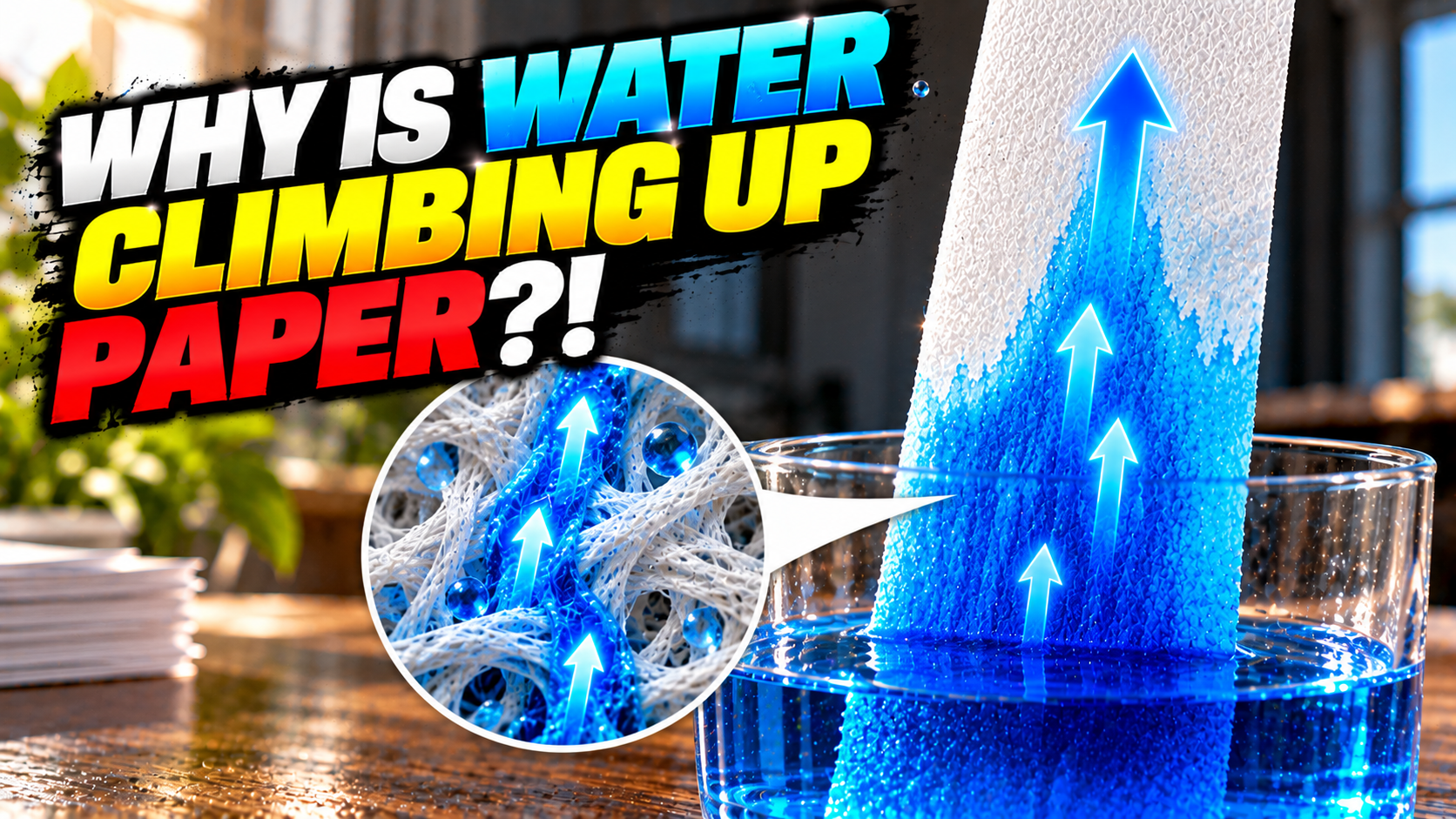
Place the bottom edge of a strip of paper into a glass of colored water.
At first, only the submerged portion becomes wet.
But after a short time, something surprising happens.
Water begins to travel upward through the paper, even though gravity pulls liquids downward.
There is no pump, motor, or external pressure system pushing the water upward.
So how can an ordinary sheet of paper transport water against gravity?
The answer lies in capillary action, a physical phenomenon involving surface tension, wetting, and the microscopic spaces inside porous materials.
Paper contains an interconnected network of cellulose fibers. Between these fibers are countless small pores that can serve as pathways for liquid movement.
When water encounters a suitable paper surface, capillary forces can drive it into these narrow spaces.
Scientists study this process using concepts such as capillary pressure, contact angle, viscosity, and the Lucas–Washburn equation.
These principles are important not only for understanding paper towels but also for developing paper-based microfluidic devices, analytical sensors, and rapid diagnostic tests.
In this article, we will explore how paper absorbs water, why liquid can rise against gravity, what determines its speed, and how researchers use capillary flow in modern technology.
1. Why Does Paper Absorb Water?
Ordinary paper is a porous material made from cellulose fibers.
A porous material contains small internal spaces through which gases or liquids may travel.
In paper, pores exist between fibers, while additional water-accessible regions may exist within the fiber structure itself.
When water contacts the paper, it can enter these spaces.
One important factor is the hydrophilic nature of cellulose.
Hydrophilic materials interact favorably with water.
Cellulose contains hydroxyl groups that can form hydrogen bonds with water molecules.
Under suitable surface conditions, water can wet cellulose fibers and penetrate the paper’s internal structure.
However, not all paper absorbs water equally.
Some papers are coated or chemically treated to limit liquid penetration.
For example, sizing treatments can reduce the rate at which water enters the sheet.
The absorbency of paper therefore depends on fiber composition, manufacturing methods, pore structure, and surface treatments.
2. What Is Capillary Action?
Capillary action describes the movement of a liquid through narrow spaces as a result of interfacial forces.
These forces are related to surface tension and the interaction between the liquid and the surrounding solid surface.
A familiar example occurs when a thin glass tube is placed into water.
Under appropriate wetting conditions, water can rise inside the tube above the level of the surrounding liquid.
Gravity still acts on the water.
However, capillary forces can drive the liquid upward until they are balanced by opposing effects.
A similar process occurs inside paper.
The important difference is that paper does not contain one smooth, cylindrical tube.
Instead, it contains a complicated network of interconnected pores with different shapes and sizes.
Therefore, liquid transport through paper is more complex than flow through a single ideal capillary.
Nevertheless, capillary action provides the fundamental explanation for why paper can absorb and transport water without a pump.
3. What Role Does Surface Tension Play?
Surface tension is a physical property associated with the energy of a liquid interface.
Water molecules interact with one another through intermolecular forces.
Molecules at the liquid surface experience a different environment from molecules inside the liquid.
This gives the liquid surface characteristic energetic and mechanical behavior.
Inside a narrow pore, the boundary between water and air may form a curved surface called a meniscus.
A curved liquid interface can create a pressure difference between the liquid and the surrounding gas.
This pressure difference is related to capillary pressure.
Under suitable wetting conditions, capillary pressure can drive water into narrow spaces.
However, surface tension alone does not determine whether water will enter a particular material.
The interaction between the liquid and the solid surface is also essential.
This interaction is commonly described using the contact angle.
4. What Is the Contact Angle?
The contact angle is the angle formed where a liquid interface meets a solid surface.
It provides information about how a liquid wets that surface.
A relatively small contact angle generally indicates favorable wetting.
A larger contact angle suggests that the liquid is less inclined to spread across the surface.
Hydrophilic surfaces often exhibit relatively small water contact angles.
Hydrophobic surfaces generally exhibit larger contact angles.
In capillary systems, the contact angle affects the direction and magnitude of capillary forces.
When water wets the walls of a narrow passage sufficiently well, capillary pressure can promote liquid movement into the passage.
However, measuring contact angles on paper is more complicated than measuring them on smooth, nonporous materials.
Paper is rough, chemically heterogeneous, and porous.
Water may begin penetrating the surface while the measurement is taking place.
Therefore, apparent contact angles on paper must be interpreted carefully.
5. How Is Capillary Pressure Generated?
Capillary pressure arises from the pressure difference across a curved liquid interface.
This behavior is described by the Young–Laplace equation.
For a simplified cylindrical capillary, the pressure difference depends on surface tension, contact angle, and tube radius.
A commonly used expression is:
ΔP = 2γ cosθ / r
Here:
ΔP represents capillary pressure.
γ represents the liquid’s surface tension.
θ represents the contact angle.
r represents the radius of the capillary.
Under wetting conditions where cosθ is positive, a smaller capillary radius produces a larger capillary pressure magnitude when other factors remain constant.
This means narrow pores can generate a strong driving force for liquid penetration.
However, narrow passages also produce greater resistance to flow.
Therefore, smaller pores do not necessarily make water travel faster.
The rate of liquid movement depends on the balance between capillary driving pressure and viscous resistance.
In real paper, pores vary in size and shape, making the flow behavior more complicated.
6. What Is the Lucas–Washburn Equation?
The Lucas–Washburn equation is one of the most important models used to describe capillary penetration.
It relates the distance traveled by a liquid to the time elapsed.
For a simplified horizontal cylindrical capillary under appropriate assumptions, the relationship can be written as:
L² = (rγ cosθ / 2η)t
Here:
L is the distance traveled by the liquid.
r is the capillary radius.
γ is surface tension.
θ is the contact angle.
η is dynamic viscosity.
t is elapsed time.
This equation shows that the square of the penetration distance is proportional to time.
In simplified form:
L² ∝ t
Therefore:
L ∝ √t
The liquid penetration distance increases approximately with the square root of time under the model’s assumptions.
This means liquid movement is often relatively fast at the beginning and slows as the penetration distance increases.
However, the basic equation assumes idealized conditions and does not include every effect relevant to real paper.
Gravity, evaporation, fiber swelling, and complex pore geometry can cause deviations from the model.
7. Why Does Water Move More Slowly Over Time?
When the edge of a dry paper strip first touches water, the wetting front may advance quickly.
As time passes, its movement often slows.
One important reason is increasing viscous resistance.
Viscosity describes a fluid’s resistance to deformation and flow.
As water travels farther through a narrow passage, a longer region of the passage becomes filled with liquid.
The longer flow path creates greater resistance to continued movement.
Capillary pressure may still pull water forward, but the flow rate decreases.
In a vertical paper strip, gravity adds another opposing effect.
As water rises, the hydrostatic pressure associated with the height of the liquid column increases.
Eventually, capillary driving forces may be balanced by gravity and other effects.
This helps explain why water does not rise indefinitely.
8. Can Water Rise Infinitely High Through Paper?
Capillary action can move water upward, but the rise is not unlimited.
Gravity opposes the upward movement of the liquid.
As the liquid rises, the hydrostatic pressure difference increases.
In an ideal cylindrical capillary, an equilibrium height can be estimated using Jurin’s law:
h = 2γ cosθ / (ρgr)
Here:
h is the equilibrium capillary rise height.
γ is surface tension.
θ is the contact angle.
ρ is the liquid density.
g is gravitational acceleration.
r is the capillary radius.
This expression describes a balance between capillary forces and gravity under ideal conditions.
However, paper contains irregular pores rather than one uniform tube.
Evaporation, pore connectivity, fiber swelling, and environmental humidity may also affect the observed rise.
Therefore, the final height in a paper strip may differ significantly from the prediction of a simple capillary model.
9. Do Smaller Pores Always Make Water Rise Faster?
It might seem logical that narrower pores would transport water more effectively because they generate stronger capillary pressure.
However, this is only part of the explanation.
In a simplified capillary, reducing the radius increases the magnitude of capillary pressure under suitable wetting conditions.
At the same time, narrow passages increase viscous resistance.
The Lucas–Washburn equation illustrates that the relationship between pore radius and penetration speed is not determined by pressure alone.
Under its ideal assumptions, a larger capillary radius can produce faster horizontal penetration even though the capillary pressure is lower.
Real paper introduces further complications.
Its pore network contains channels of different sizes and shapes.
Some pathways may support relatively rapid liquid movement.
Others may retain liquid or contribute to slower redistribution.
Therefore, paper absorbency cannot be predicted from average pore size alone.
Researchers must also consider pore connectivity, wettability, permeability, and the overall fiber network.
10. Why Do Paper Towels and Printer Paper Absorb Water Differently?
Paper towels and printer paper are both commonly made from cellulose fibers.
However, they are designed for different purposes.
Paper towels are generally engineered to absorb and retain liquids.
Their fiber structure, pore network, and surface properties are selected with absorbency in mind.
Printer paper is designed to provide reliable printing performance, dimensional stability, and controlled interactions with inks and moisture.
Sizing treatments may be used to reduce excessive liquid penetration.
These differences influence how quickly water enters the material and how much water it can hold.
However, it would be inaccurate to claim that every paper towel absorbs water faster than every type of printer paper.
Performance depends on the specific product, fiber composition, manufacturing process, and surface treatment.
Comparing absorbency requires controlled measurements rather than assumptions based solely on the product category.
11. What Are Paper-Based Microfluidic Devices?
Capillary action in paper has applications far beyond cleaning up spilled liquids.
Scientists use porous materials to develop small devices that transport and analyze liquid samples.
One important category is paper-based microfluidic devices.
Microfluidics is the science and engineering of controlling fluids in small-scale systems.
Paper-based microfluidic devices use porous structures to move liquids through defined pathways.
In some designs, capillary forces can transport samples without external pumps.
Researchers may create hydrophilic channels surrounded by hydrophobic barriers.
This allows liquid movement to be directed toward specific reaction zones.
Such devices are investigated for chemical analysis, environmental monitoring, and point-of-care testing.
Their potential advantages include simple structures and the ability to operate with small sample volumes.
However, performance depends on careful control of materials, liquid transport, and chemical reactions.
12. Do Pregnancy Tests Use Capillary Action?
Many rapid diagnostic tests use capillary-driven transport through porous materials.
A major example is the lateral flow assay.
In a lateral flow assay, a liquid sample travels through a series of porous components.
As the sample moves, it encounters reagents designed to detect a target substance.
Pregnancy tests are a familiar example of this technology.
However, these devices are not necessarily made from ordinary writing paper.
Many lateral flow assays use nitrocellulose membranes along with sample pads, conjugate pads, and absorbent pads.
Each component performs a specific function.
Capillary transport helps move the sample through the device.
Chemical and biological recognition processes then produce a detectable result.
Therefore, capillary action is an important part of how many rapid tests function, but it is not the only scientific principle involved.
13. Can Scientists Control the Direction of Water Flow in Paper?
Researchers can modify the surface properties of paper to influence where water travels.
One method involves creating regions with different wetting characteristics.
Hydrophilic areas allow water to penetrate relatively easily.
Hydrophobic regions resist water penetration.
By arranging these regions into patterns, scientists can create defined liquid pathways.
A commonly studied method is wax patterning.
In wax patterning, wax is applied to selected areas of paper to create hydrophobic barriers.
These barriers can help confine liquid movement to designated channels.
However, reliable device performance requires more than drawing a pattern.
The distribution of wax, pore structure, liquid composition, evaporation, and manufacturing consistency can all affect flow.
Precise control is essential when the device is intended for chemical analysis or diagnostic applications.
14. Why Do Scientists Study Water Transport Through Paper?
Capillary flow in paper is important in several scientific and industrial fields.
In papermaking, it helps researchers understand absorbency and interactions between paper and printing liquids.
In packaging research, it contributes to evaluating liquid penetration and barrier performance.
In microfluidics, it provides a mechanism for moving small liquid volumes without conventional pumping systems.
In analytical chemistry, porous substrates can support compact testing devices.
However, paper-based fluid transport also presents challenges.
Flow rates can vary with material structure and environmental conditions.
Evaporation may change the concentration of dissolved substances.
Nonuniform wetting can affect measurement accuracy.
Some samples may interact with the cellulose or other components of the substrate.
Therefore, reliable applications require a detailed understanding of both fluid behavior and material properties.
15. A Simple Experiment to Observe Capillary Action in Paper
You can observe capillary rise using a few everyday materials.
You will need a transparent glass, water, food coloring, a paper towel, and a ruler.
Step 1: Prepare Colored Water
Fill the glass with a small amount of water.
Add a few drops of food coloring so the movement of liquid is easier to observe.
Step 2: Prepare a Paper Strip
Cut a paper towel into a long, narrow strip.
Try to keep its width reasonably uniform.
Step 3: Place the Strip in Water
Dip only the bottom edge of the paper strip into the colored water.
Keep the remaining portion as vertical as possible.
Step 4: Observe the Movement
Watch as the colored region begins to rise through the paper.
Record the height reached at regular time intervals.
Step 5: Compare Distance and Time
Measure the approximate distance traveled by the colored front.
You may notice that the rate of upward movement decreases over time.
This behavior is consistent with the influence of viscous resistance and, for vertical rise, gravity.
However, the boundary of the food coloring may not exactly match the true water front.
Dye adsorption, evaporation, and nonuniform pore structure can affect the observation.
Therefore, this activity is best used to demonstrate capillary action rather than to perform a precise validation of the Lucas–Washburn equation.
16. The Future of Paper-Based Capillary Flow Technology
Capillary action reveals that ordinary paper is more than a passive sheet of fibers.
Its microscopic pore network can transport liquid through interfacial forces.
By modifying fiber structure and surface chemistry, researchers can influence how fluids move through paper-based materials.
This capability is valuable for the development of microfluidic devices and analytical systems.
In some applications, paper-based structures may reduce the need for external pumps and complex fluid-handling equipment.
However, practical devices must provide reliable and repeatable flow.
Researchers must address variations in paper structure, evaporation, sample interactions, and environmental sensitivity.
Future advances may involve more precise manufacturing methods and improved control of pore geometry and surface wettability.
Paper-based capillary technologies demonstrate how a familiar material can support sophisticated applications in fluid mechanics, analytical chemistry, and sensor engineering.
Conclusion: Paper Can Transport Water Through Microscopic Capillary Forces
Water rising through paper is not a violation of gravity.
It is the result of capillary action within a network of microscopic pores.
Surface tension and wetting interactions create capillary pressure that can drive liquid into suitable pathways.
At the same time, viscosity, gravity, evaporation, and pore structure influence the movement.
The Lucas–Washburn equation provides a useful model for understanding capillary penetration under idealized conditions.
It predicts that the square of the penetration distance is proportional to time.
However, real paper contains a complex and irregular network of pores, so its behavior may differ from that of an ideal cylindrical capillary.
The same principles that allow a paper towel to absorb water can also support paper-based microfluidic devices and certain rapid diagnostic technologies.
Ultimately, a sheet of paper is not simply a collection of cellulose fibers.
It is a porous material containing an intricate network of microscopic pathways.
Within that network, the interaction between liquids and solid surfaces produces fluid movement that can be studied, predicted, and engineered.
This is what makes capillary action one of the most fascinating examples of physics hidden inside an everyday material.
Insight 50’s Paper Science series explores the structure, physical and chemical properties, manufacturing technologies, and advanced applications of paper through accessible explanations grounded in materials science.