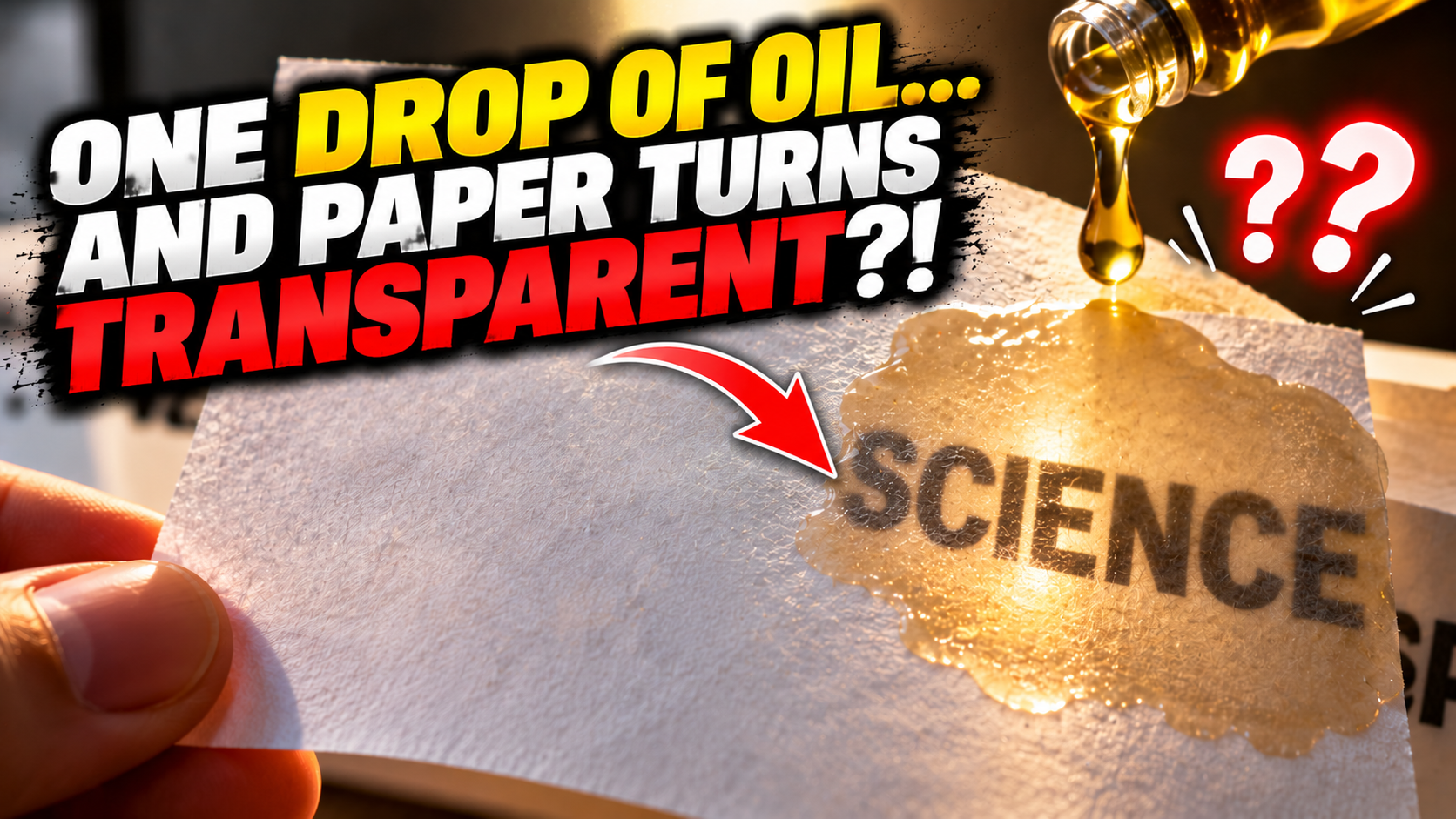
Take an ordinary sheet of white paper and hold it in front of your eyes.
Although the paper is extremely thin, you usually cannot see objects clearly through it.
Now imagine placing a single drop of cooking oil on the same sheet.
As the oil spreads into the paper, something surprising happens.
The affected area may become darker and more translucent, allowing light and objects behind the paper to become more visible.
But why?
The paper has not suddenly become thinner, and no hole has appeared in its surface.
Instead, the way light travels through the paper has changed.
The explanation lies in the microscopic structure of paper, the difference between the refractive indices of materials, and a phenomenon known as light scattering.
Paper is a porous material composed of interconnected cellulose fibers.
Inside this network are numerous microscopic spaces that normally contain air.
When light enters paper, it encounters boundaries between cellulose fibers and air.
These boundaries can redirect light repeatedly, making the material appear white and opaque.
However, when oil fills some of these spaces, the optical properties of the material change.
In this article, we will explore why paper appears white, how opacity is measured, why oil makes paper translucent, and how papermakers control the optical properties of different paper products.
1. Why Does Paper Look White?
The white appearance of paper is not simply the result of using a white-colored material.
Most conventional paper consists primarily of cellulose fibers.
Cellulose does not strongly absorb most wavelengths of visible light under ordinary conditions.
However, the internal structure of paper contains a large number of fibers and microscopic air spaces.
When light reaches the surface, some of it is reflected while some enters the material.
Inside the paper, the light encounters many boundaries between cellulose and air.
At these boundaries, the direction of light can change.
This process is called light scattering.
Some of the scattered light eventually returns toward the surface from which it entered.
When a substantial amount of visible light is scattered back toward the observer, the paper appears bright.
If the different wavelengths of visible light are reflected relatively evenly, the paper can appear white.
However, the exact color of paper also depends on its chemical composition.
Residual lignin, bleaching processes, mineral fillers, and optical brightening agents can all influence its appearance.
Therefore, the whiteness of paper results from a combination of chemical composition and microscopic optical behavior.
2. What Is Optical Opacity in Paper?
Optical opacity is an important property used to describe how effectively paper conceals objects or printed content behind it.
In everyday language, an opaque material is often described as something that does not allow light to pass through.
However, opacity in papermaking is a more specific measurable optical property.
For example, imagine printing text on both sides of a sheet.
If the text on the reverse side is clearly visible from the front, the paper may have relatively low opacity.
If the reverse-side text is difficult to see, the paper may have higher opacity.
In the paper industry, opacity is commonly evaluated using standardized reflectance measurements.
Different standards may use different measurement conditions or definitions.
Therefore, opacity values should be interpreted according to the relevant test method.
Importantly, opacity is not determined by paper thickness alone.
Fiber structure, light scattering, absorption, mineral fillers, and manufacturing processes all influence the final result.
3. Why Does Paper Contain So Many Microscopic Air Spaces?
Paper is manufactured by dispersing plant-derived fibers in water, forming a thin fibrous web, and removing water through drainage, pressing, and drying.
During this process, the fibers overlap and bond with one another.
However, they do not fill every available space.
Microscopic voids remain between and around the fibers.
These spaces are called pores.
Because of this internal structure, paper is classified as a porous material.
The size, shape, and distribution of pores depend on the raw materials and manufacturing conditions.
For example, pressing and surface treatments can change the density and pore structure of a sheet.
These structural differences influence several paper properties.
They affect liquid absorption, air permeability, density, and mechanical performance.
They also affect how light moves through the material.
The numerous interfaces between fibers and air provide important locations for light scattering.
Therefore, the air spaces inside paper are not merely empty gaps.
They are essential features that help determine the paper’s optical appearance.
4. How Does Refractive Index Cause Light Scattering?
To understand why paper scatters light, we need to examine a concept called refractive index.
Refractive index describes an optical property of a material that influences how light propagates through it.
Air has a refractive index close to 1.
Cellulose has a significantly higher refractive index, although its exact value depends on factors such as measurement direction and conditions.
When light encounters a boundary between materials with different refractive indices, reflection and refraction can occur.
Refraction is the change in the direction of light as it travels between materials with different optical properties.
Inside paper, light encounters countless boundaries between cellulose fibers and air.
Because the fibers are irregularly arranged, these boundaries face many different directions.
As light passes through the sheet, its direction may change repeatedly.
This repeated redirection is known as multiple scattering.
Multiple scattering reduces the amount of light that travels straight through the paper.
As a result, objects behind the sheet become difficult to see clearly.
The strength of this scattering depends on more than the refractive index difference.
Fiber dimensions, pore structure, wavelength, and the arrangement of the material also matter.
5. Why Does Oil Make Paper Translucent?
Now we can explain the most interesting phenomenon.
When cooking oil is applied to ordinary paper, the liquid can penetrate the microscopic pores between the fibers.
As the oil spreads, it replaces some of the air inside the paper.
This changes the optical boundaries within the material.
Most common oils have refractive indices that are closer to that of cellulose than the refractive index of air.
Consequently, the difference in refractive index between the fibers and their surroundings becomes smaller in the oil-filled regions.
When this difference decreases, light scattering at those boundaries may also decrease.
More light can then travel through the paper without being redirected as strongly.
As a result, the oil-soaked region may become more translucent.
This phenomenon is related to refractive index matching.
Refractive index matching occurs when the optical properties of neighboring materials become more similar, reducing certain effects at their interfaces.
However, oil does not necessarily make paper completely transparent.
The paper still contains a complex fiber network.
Some pores may remain unfilled, and scattering can continue at other interfaces.
The final appearance depends on the type of paper, the oil, and how thoroughly the liquid penetrates the sheet.
This is why oil-soaked paper usually becomes translucent rather than perfectly transparent like glass.
6. Why Does Oil-Soaked Paper Look Darker?
Oil-soaked paper often looks darker than the surrounding dry paper.
At first, this may seem contradictory.
If more light passes through the paper, why does the surface look darker?
The answer involves the amount of light returning toward the observer.
In dry paper, multiple scattering sends a substantial portion of the incoming light back toward the front surface.
This makes the paper appear bright.
When oil fills the pores, scattering may decrease.
Consequently, less light may return toward the observer from the front side.
At the same time, more light may travel through the sheet.
Under suitable viewing conditions, the oil-soaked region therefore appears darker than the dry region.
However, its exact appearance depends on the lighting arrangement, the color of the background, and the type of oil.
A translucent patch placed over a dark background may appear very different from the same patch held against a bright light.
This demonstrates that the visible appearance of paper depends not only on its chemical color but also on the movement of light within its structure.
7. Can Water Also Make Paper Translucent?
Yes. Water can sometimes produce a similar effect.
When water penetrates paper, it can replace some of the air within the pore structure.
The refractive index of water is approximately 1.33, which is closer to that of cellulose than the refractive index of air.
Therefore, water can reduce some of the refractive index differences responsible for scattering.
As a result, wet paper may appear more translucent than dry paper.
However, water and oil do not behave identically.
Water interacts strongly with cellulose and can cause the fibers to swell.
This swelling may change the physical structure of the sheet.
Water also evaporates under ordinary conditions.
As the paper dries, the liquid-filled pores can become air-filled again, changing the optical behavior.
Cooking oil, by comparison, is generally much less volatile.
It may remain within the paper for a much longer time.
The effects of different liquids also depend on viscosity, surface tension, wetting behavior, and their interactions with cellulose.
Therefore, the degree and duration of translucency vary with the liquid and the paper.
8. Is Thicker Paper Always More Opaque?
Increasing paper thickness often increases the distance that light must travel through the fibrous structure.
Under otherwise comparable conditions, this can increase the number of scattering events.
Consequently, thicker paper often exhibits greater opacity.
However, thickness is not the only determining factor.
Two sheets with the same thickness can have very different optical properties.
For example, differences in fiber structure and pore distribution can affect scattering.
Density and mineral filler content can also influence opacity.
A relatively thin paper may be engineered to provide high opacity.
Conversely, a thicker paper with a different internal structure may transmit more light than expected.
Therefore, opacity is a property determined by the combined effects of thickness, microscopic structure, and material composition.
9. How Do Papermakers Increase Paper Opacity?
The paper industry uses several techniques to control opacity.
One important method involves adding mineral fillers.
Fillers are fine particles incorporated into paper to modify properties such as optical appearance, surface characteristics, and printability.
Common examples include calcium carbonate and kaolin clay.
These particles can influence how light scatters within the sheet.
Their effectiveness depends on factors such as particle size, distribution, refractive index, and interactions with the fiber network.
Titanium dioxide is another important material.
It is a white pigment with a high refractive index and can provide strong light-scattering effects in certain paper applications.
However, increasing filler content does not automatically improve every aspect of paper quality.
Fillers can influence mechanical strength and other performance characteristics.
Manufacturers must therefore balance opacity, strength, surface properties, and production costs.
The goal is to produce paper with optical performance appropriate for its intended use.
10. Does Compressing Paper Change Its Optical Properties?
During papermaking, paper may undergo mechanical treatments that modify its surface and thickness.
One example is calendering.
Calendering involves passing paper through rollers to adjust properties such as smoothness, thickness, and surface finish.
The process can change the density and pore structure of the sheet.
Because pores and fiber interfaces influence light scattering, these structural changes can also affect optical properties.
Under some conditions, compression reduces the number or effectiveness of air–fiber scattering interfaces.
This may reduce opacity.
However, the outcome depends on the paper composition and processing conditions.
Calendering can also influence gloss.
A smoother surface may reflect light differently from a rough surface.
Therefore, calendering is not simply a process for making paper thinner or smoother.
It is also an important tool for controlling the optical appearance of paper products.
11. Why Do Newspaper and Printer Paper Have Different Levels of Show-Through?
Newspaper and office printer paper are designed for different purposes.
Newsprint is often manufactured with an emphasis on large-scale printing and cost efficiency.
Office paper must satisfy requirements related to printer feeding, print quality, mechanical strength, and handling.
These products can differ in fiber composition, fillers, basis weight, and surface treatment.
Such differences influence opacity.
Opacity is particularly important in double-sided printing.
If the paper does not sufficiently conceal printing on the reverse side, text and images may interfere with readability.
However, not all visible show-through is caused by low opacity alone.
Printing ink can also penetrate into paper.
In some cases, ink penetration produces visible effects on the opposite side.
Therefore, it is important to distinguish between optical show-through and ink penetration.
The first relates to how light travels through the sheet.
The second involves the movement of printing materials within the paper structure.
Both can affect the final appearance of printed products.
12. How Is Paper Opacity Measured?
Paper opacity can be evaluated through standardized optical measurements.
Rather than relying only on visual inspection, laboratories use instruments to measure the reflectance of paper under controlled conditions.
One common approach compares the reflectance of a sheet placed over a black backing with the reflectance of a sufficiently thick stack of the same paper.
The measurements are performed according to the conditions defined by the applicable standard.
Specialized instruments use controlled illumination and viewing geometries.
However, different opacity standards may produce values that are not directly interchangeable.
The test method must therefore be considered when comparing results.
Other optical properties are also measured in the paper industry.
These include brightness, whiteness, and gloss.
Each property describes a different aspect of how paper interacts with light.
Together, these measurements help manufacturers maintain consistent product quality.
13. A Simple Experiment: Make Paper Translucent with Oil
You can observe changes in paper transparency using a simple household experiment.
You will need a sheet of ordinary white paper, a small amount of cooking oil, a cotton swab or brush, and a flashlight.
Step 1: Prepare the Paper
Place a sheet of paper on a clean surface.
Choose a small area for the experiment.
Step 2: Apply a Small Amount of Oil
Use a cotton swab or brush to apply a small amount of cooking oil to the selected area.
Allow the oil to penetrate the paper.
Step 3: Shine Light Through the Paper
Hold a flashlight behind the sheet.
Compare the oil-soaked area with the surrounding dry paper.
Step 4: Observe the Difference
Depending on the paper type, the oil-soaked area may allow more light to pass through.
Objects or patterns behind the paper may become easier to distinguish.
Step 5: Consider the Explanation
The oil has replaced some of the air within the paper’s pores.
This reduces certain refractive index differences and can decrease light scattering.
The experiment provides a visual demonstration of how microscopic structure affects optical properties.
However, the results depend on paper thickness, coatings, oil composition, and lighting conditions.
Because oil may permanently stain paper, avoid performing the experiment on important documents or books.
14. Why Is Research on Paper Optics Important?
The optical properties of paper are important in many industries.
In printing, opacity and whiteness influence readability and color reproduction.
In packaging, optical characteristics can determine how effectively a material conceals or reveals its contents.
Specialty papers may be engineered to diffuse light or provide particular transmission characteristics.
Paper-based sensors and functional materials may also rely on controlled interactions between light and fibrous structures.
These applications connect papermaking with optics, materials science, and printing engineering.
By changing the internal structure of a cellulose-based material, manufacturers can produce papers with different optical functions.
This demonstrates that paper is not simply a passive writing surface.
It is an engineered material whose properties can be adjusted through fiber selection, chemical composition, and manufacturing processes.
Conclusion: Paper Opacity Is Created by Its Microscopic Structure
The reason ordinary paper appears opaque is closely connected to light scattering within its fibrous structure.
Paper contains cellulose fibers and microscopic air spaces.
When light encounters boundaries between these materials, differences in refractive index can cause reflection and refraction.
Because these boundaries occur throughout the sheet, light is repeatedly scattered.
This makes it difficult to see objects clearly through the paper.
When oil or water fills some of the pores, the optical contrast between cellulose and the surrounding material can decrease.
As a result, scattering may become weaker and more light can pass through the sheet.
The affected region may therefore appear translucent.
The same principles help explain why paper thickness, density, mineral fillers, and surface treatments influence opacity.
Papermakers use this knowledge to design printing papers, packaging materials, and specialty products with specific optical characteristics.
A seemingly ordinary white sheet of paper is actually a complex optical material.
The next time you notice a translucent oil stain on paper, remember that the change is not simply about the paper getting wet.
It is evidence that the microscopic pathways of light inside the material have changed.
Insight 50’s Paper Science series explores the structure, physical and chemical properties, manufacturing technologies, and everyday scientific behavior of paper through accessible explanations grounded in materials science.