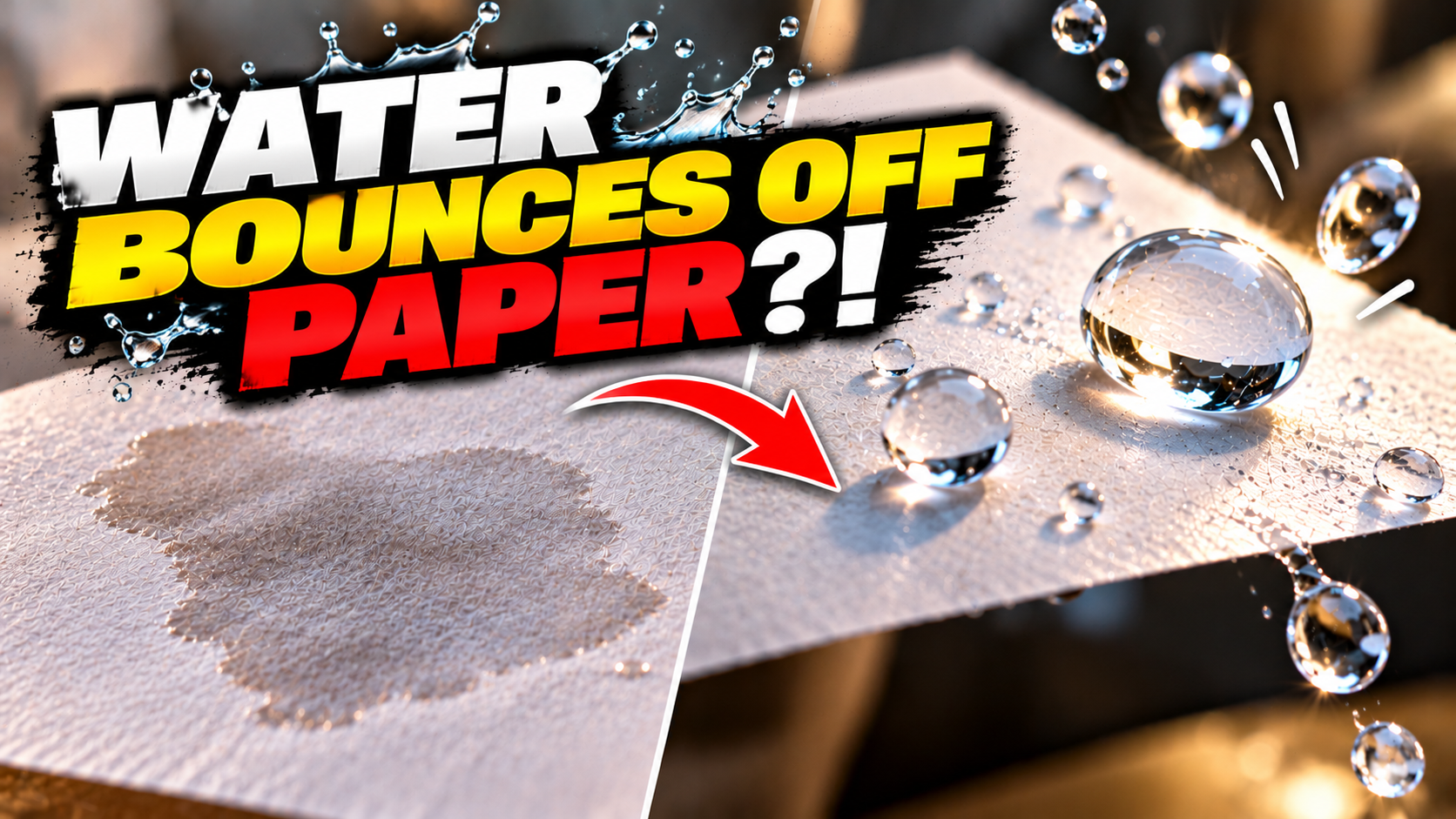
What happens when a drop of water lands on a sheet of paper?
On ordinary printer paper or tissue, the water often spreads across the surface or penetrates into the fibers.
But imagine a completely different result.
Instead of soaking into the paper, the water forms a nearly spherical droplet. When the sheet is tilted slightly, the droplet rolls away as if the paper were coated with an invisible protective layer.
This may sound surprising, but researchers have developed paper surfaces that exhibit this remarkable behavior.
The science behind it is called superhydrophobicity.
Although cellulose, the primary component of paper, naturally interacts with water, its surface properties can be modified through chemical treatments and microscopic structural engineering.
The result can be a material that strongly resists wetting.
This technology is closely related to the famous Lotus Effect, a natural phenomenon observed on lotus leaves.
In this article, we will explore why ordinary paper absorbs water, how scientists measure surface wettability, what makes a surface superhydrophobic, and how this technology could influence the future of paper-based materials.
1. Why Does Ordinary Paper Absorb Water?
Most conventional paper is manufactured from cellulose fibers obtained from plants.
Cellulose is a natural polymer composed of repeating glucose units.
Its molecular structure contains numerous hydroxyl groups.
These chemical groups can form hydrogen bonds with water molecules.
As a result, cellulose generally has a strong affinity for water.
However, the chemical properties of cellulose are only part of the explanation.
Paper also contains a network of microscopic pores between its fibers.
When water reaches the surface, it may spread across the fibers and enter these spaces.
The movement of liquid through narrow pores is related to capillary action.
Capillary action occurs because of interactions between the liquid, the solid surface, and the liquid’s surface tension.
This is why many untreated paper products absorb water relatively easily.
However, not all paper behaves the same way.
Paper composition, pore structure, coatings, and manufacturing treatments can significantly change how quickly water penetrates a sheet.
2. What Is the Difference Between Hydrophilic and Hydrophobic Surfaces?
The interaction between water and a solid surface is often described using two terms: hydrophilic and hydrophobic.
A hydrophilic surface is relatively easy for water to wet.
On such a surface, a water droplet tends to spread rather than maintain a highly rounded shape.
A hydrophobic surface resists wetting.
Water droplets on hydrophobic materials tend to remain more rounded.
For example, water may spread across clean glass under suitable conditions.
By contrast, water droplets often form rounded beads on certain water-repellent coatings.
These differences are related to the interfacial properties of the solid and liquid.
For paper, the situation is more complex because the material is both rough and porous.
The chemical composition of cellulose matters, but surface roughness and pore structure also influence wetting behavior.
By modifying these properties, scientists can dramatically change how water interacts with paper.
3. What Is a Water Contact Angle?
One of the most important concepts in surface science is the contact angle.
The contact angle describes the angle formed at the boundary where a liquid droplet meets a solid surface.
It provides useful information about how well a liquid wets a material.
A surface with a water contact angle below 90 degrees is generally classified as hydrophilic.
A surface with a contact angle above 90 degrees is generally classified as hydrophobic.
A superhydrophobic surface is commonly characterized by a static water contact angle of at least 150 degrees.
However, a high contact angle alone does not guarantee that a water droplet will roll off easily.
Some surfaces can hold droplets firmly in place even when they appear nearly spherical.
For this reason, researchers also examine droplet mobility.
One useful measurement is the sliding angle or roll-off angle.
This describes the inclination at which a droplet begins to move across a surface under specified testing conditions.
A surface that combines a very high contact angle with low droplet adhesion can exhibit the dramatic water-repellent behavior associated with superhydrophobicity.
4. Why Do Water Droplets Roll Off Lotus Leaves?
Lotus leaves are among the best-known natural examples of water-repellent surfaces.
When water lands on a lotus leaf, droplets can remain rounded and move easily across its surface.
This behavior is not caused by surface chemistry alone.
The leaf also has a complex microscopic structure.
Its surface contains small protrusions, along with even finer structures at the nanoscale.
These features are combined with naturally occurring water-repellent surface substances.
Together, they create conditions in which water may contact only the upper parts of the surface structure.
Air can remain trapped in the spaces beneath the droplet.
This reduces the effective contact area between the water and the solid surface.
The resulting behavior is commonly known as the Lotus Effect.
The Lotus Effect has inspired research into artificial superhydrophobic coatings and self-cleaning materials.
However, roughness alone is not enough to reproduce it.
The surface chemistry and microscopic structure must work together.
5. Does a Rougher Surface Always Repel Water Better?
Surface roughness strongly influences wetting behavior, but increasing roughness does not automatically make a material hydrophobic.
In fact, roughness can amplify the original wetting characteristics of a surface.
A rough hydrophilic surface may become even easier to wet.
On the other hand, a suitably structured hydrophobic surface may exhibit stronger water repellency.
Scientists often describe these effects using two important models.
The Wenzel Model
The Wenzel model describes a situation in which a liquid follows the contours of a rough solid surface.
The liquid penetrates the surface texture and contacts the material throughout the rough region.
The Cassie–Baxter Model
The Cassie–Baxter model describes a composite contact state in which a droplet rests partly on the solid surface and partly over trapped air.
This can reduce the actual area of contact between water and the solid.
The Cassie–Baxter state is particularly important in many low-adhesion superhydrophobic surfaces.
However, real paper surfaces are more complicated than idealized models.
Water can penetrate pores, fibers may swell, and the surface structure can change during wetting.
Therefore, researchers must consider both theoretical wetting models and the actual behavior of the material.
6. How Can Scientists Make Paper Superhydrophobic?
Creating superhydrophobic paper generally involves controlling two major factors.
The first is surface chemistry.
Scientists can modify the paper surface to reduce its affinity for water.
The second is microscopic surface structure.
Carefully designed micro- and nanoscale features can influence how water droplets contact the material.
Researchers have investigated various approaches, including wax-based treatments, silane-based surface modifications, polymer coatings, and particle-assisted surface texturing.
Some techniques create a water-repellent chemical layer.
Others introduce surface roughness that supports the formation of air pockets beneath droplets.
Combining these effects can produce paper surfaces on which water beads up rather than spreading.
However, the results depend on the paper substrate, coating materials, and manufacturing process.
Because paper is porous, researchers must also consider whether the treatment only modifies the outer surface or prevents liquid from entering the internal fiber network.
7. Is Waterproof Paper the Same as Superhydrophobic Paper?
Waterproofness and superhydrophobicity are related, but they are not identical.
Waterproofness describes a material’s ability to resist water penetration or transmission.
Superhydrophobicity primarily describes how water droplets interact with a surface.
For example, a superhydrophobic sheet may repel droplets on its outer surface.
However, water might still penetrate through damaged areas, cut edges, or untreated regions.
A coating can also lose its water-repellent properties if the surface texture becomes damaged.
Conversely, a material may provide an effective barrier against water penetration without allowing droplets to roll off easily.
Therefore, a high water contact angle does not automatically mean that a paper product is completely waterproof.
For packaging applications, manufacturers must evaluate both surface wettability and actual water-barrier performance.
Understanding this distinction is essential when designing functional paper products.
8. What Is the Self-Cleaning Effect?
One of the most interesting potential benefits of superhydrophobic surfaces is self-cleaning behavior.
On certain low-adhesion surfaces, moving water droplets can collect and carry away loose particles.
This effect is commonly associated with lotus leaves.
As droplets roll across the leaf, they may remove dust and other contaminants.
Researchers have explored similar effects in engineered superhydrophobic paper.
However, self-cleaning does not mean that every type of contamination can be removed by water.
Oil-based substances, strongly adhered particles, and certain chemical contaminants may remain on the surface.
The effectiveness of self-cleaning depends on the properties of the contaminant, the surface, and the moving droplets.
Therefore, self-cleaning performance must be evaluated for the intended application rather than assumed from a high contact angle alone.
9. Why Is Superhydrophobic Paper Important for Industry?
Paper is widely used because it can be produced from renewable plant-derived raw materials.
However, sensitivity to water limits its performance in some applications.
For example, packaging materials may need to resist liquid exposure during storage, transportation, or handling.
Superhydrophobic surface treatments offer one possible way to modify the interaction between water and paper.
By reducing wetting, these treatments may help limit surface spreading and absorption under certain conditions.
Potential applications include specialty packaging, protective paper surfaces, and materials that require controlled liquid interaction.
However, successful industrial use requires more than impressive water-droplet demonstrations.
Manufacturers must consider abrasion resistance, coating uniformity, production costs, recyclability, and safety.
For food-contact applications, the suitability of the coating materials must also be assessed under applicable requirements.
Therefore, superhydrophobic paper is an engineering challenge involving multiple performance criteria.
10. Can Superhydrophobic Paper Be Environmentally Friendly?
Interest in paper-based packaging has encouraged research into alternative surface treatments.
Some researchers are investigating naturally derived waxes and bio-based polymers as potential water-repellent materials.
Others are exploring water-based processing methods or coatings that avoid certain fluorinated chemicals.
These approaches may offer advantages in specific applications.
However, using a natural or bio-based ingredient does not automatically make a product environmentally friendly.
The overall environmental impact depends on factors such as raw material production, chemical processing, durability, disposal, and recyclability.
A coating that improves water resistance may also affect how easily paper fibers can be separated during recycling.
Therefore, researchers must evaluate both functional performance and environmental consequences.
The goal is not simply to create a highly water-repellent surface.
It is to develop a material that performs reliably while meeting appropriate environmental and safety requirements.
11. How Do Researchers Test Superhydrophobic Paper?
Several experimental methods are used to evaluate superhydrophobic paper.
The most common is water contact angle measurement.
A small water droplet is placed on the paper surface, and its shape is analyzed using specialized equipment.
Researchers may also measure the angle at which a droplet begins to move when the surface is tilted.
This provides information about droplet adhesion and mobility.
However, measuring contact angles on paper can be challenging.
Paper surfaces are often rough, porous, and chemically heterogeneous.
Water may penetrate the material during measurement, causing the droplet shape to change over time.
Therefore, droplet volume, measurement timing, and environmental conditions can influence the results.
Researchers may also examine the surface using microscopy.
Additional tests can evaluate liquid absorption, abrasion resistance, and performance after repeated bending.
These measurements provide a more complete understanding of whether a treated paper surface is suitable for practical use.
12. Does Superhydrophobicity Last Forever?
Superhydrophobic performance can deteriorate over time.
For example, repeated rubbing may damage the microscopic surface structures that support water repellency.
A coating may also wear away or become contaminated.
Changes in temperature, humidity, and chemical exposure can influence the behavior of certain surface treatments.
Paper itself can expand or contract as environmental moisture changes.
These dimensional changes may affect the coating and surface structure.
Therefore, a high initial contact angle does not guarantee long-term performance.
Researchers investigate methods to improve coating adhesion, structural durability, and resistance to environmental exposure.
Mechanical durability is particularly important for paper products that are frequently folded, handled, or transported.
13. A Simple Experiment to Compare Water Repellency
You can observe differences in paper wettability using a simple experiment.
You will need ordinary printer paper, a water-repellent paper product, a small amount of water, and a dropper.
Step 1: Prepare the Samples
Place both paper samples on a flat surface.
Make sure the surfaces are clean and dry.
Step 2: Add Water Droplets
Place similarly sized water droplets on each sample.
Observe the shape of the droplets.
Step 3: Compare the Results
On ordinary printer paper, the water may spread or penetrate the fibers.
On water-repellent paper, the droplet may remain more rounded.
Step 4: Tilt the Paper
Carefully tilt each sample and observe whether the droplet moves.
A highly water-repellent surface may allow the droplet to move more easily.
However, some hydrophobic surfaces can hold droplets firmly in place.
Step 5: Interpret the Observation
The differences demonstrate how surface chemistry and structure influence water behavior.
Keep in mind that water-repellent paper is not necessarily superhydrophobic.
A reliable classification requires appropriate contact angle and droplet mobility measurements.
14. The Future of Superhydrophobic Paper Technology
Superhydrophobic paper combines several areas of science, including papermaking, surface engineering, polymer chemistry, and biomimetic materials design.
By modifying the surface of cellulose-based materials, researchers can introduce functions that ordinary paper does not naturally provide.
Potential applications include water-repellent packaging, specialty paper products, and engineered surfaces with controlled liquid interactions.
Biomimetic approaches inspired by lotus leaves and other natural structures may continue to influence this research.
However, producing a superhydrophobic surface in a laboratory is different from manufacturing a durable commercial product at large scale.
Industrial applications require consistent performance, efficient processing, reasonable costs, and compatibility with recycling or disposal systems.
Future progress will therefore depend not only on achieving high contact angles but also on developing durable and practical materials.
Conclusion: Water Repellency Can Be Engineered into Paper
Ordinary paper tends to absorb water because cellulose interacts with water molecules and the fibrous structure contains interconnected pores.
However, the way water behaves on paper can be changed through surface engineering.
By combining water-repellent surface chemistry with suitable microscopic structures, researchers can create surfaces on which droplets remain rounded and may roll away easily.
These effects are explained through concepts such as contact angle, surface wettability, the Wenzel model, and the Cassie–Baxter model.
Superhydrophobic paper has potential applications in packaging, protective materials, and specialty products.
However, practical use requires careful consideration of durability, water-barrier performance, environmental impact, and safety.
Ultimately, superhydrophobic paper demonstrates how a familiar material can gain new functions through precise control of surface chemistry and structure.
A sheet of paper that normally absorbs water can become a remarkable example of advanced materials engineering.
Insight 50’s Paper Science series explores the structure, physical and chemical properties, manufacturing technologies, and everyday scientific behavior of paper through accessible explanations grounded in materials science.