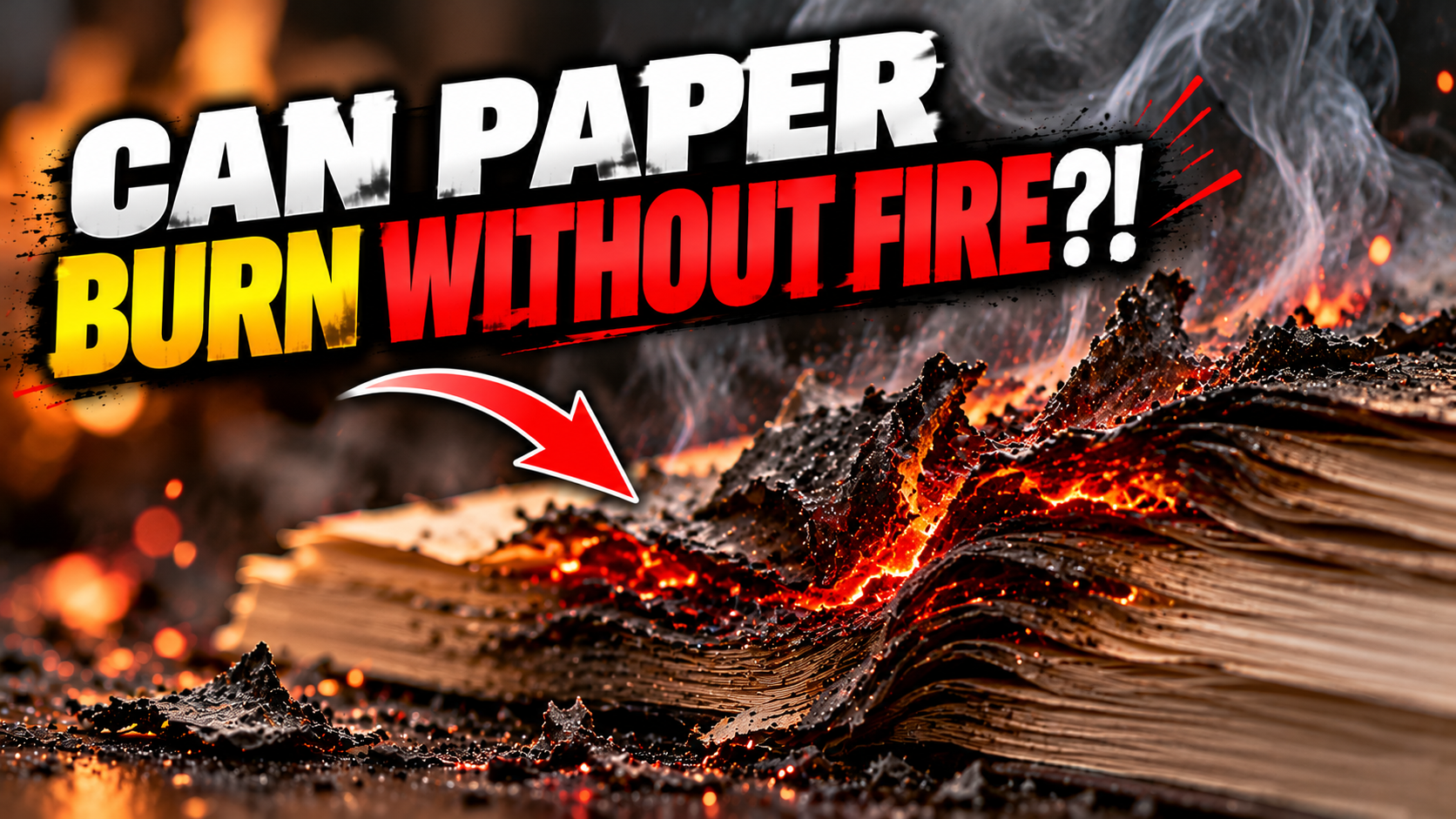
What happens when paper catches fire?
Most people imagine a sheet turning black, producing bright flames, and eventually becoming ash.
But here is a surprising fact: paper does not always need direct contact with a flame to ignite.
Under certain conditions, exposure to sufficient heat can cause paper to decompose and eventually catch fire.
Even more surprisingly, some cellulose-based materials can continue burning without producing visible flames.
Instead of a bright flame, there may be glowing embers, smoke, or slowly spreading areas of char.
Understanding these phenomena requires a closer look at cellulose, the primary structural component of paper, and the chemical reactions that occur when it is heated.
Paper is not simply a material that burns easily.
It is a complex fibrous material that undergoes chemical transformations when exposed to high temperatures.
During heating, its molecular structure changes, producing gases, volatile compounds, and carbon-rich solid residues.
In this article, we will explore the thermal decomposition of cellulose, the differences between flaming and smoldering combustion, the factors that influence paper ignition, and the scientific methods used to investigate these processes.
1. What Is Paper Made Of?
To understand how paper burns, we must first examine its composition.
Most conventional paper is manufactured from plant-derived fibers.
The main structural component of these fibers is cellulose.
Cellulose is a natural polymer made of long chains of glucose units.
Its general molecular formula is written as (C6H10O5)n.
The letter n represents the number of repeating units in the polymer chain.
Cellulose molecules form long chains that interact through hydrogen bonding and other molecular forces.
These interactions contribute to the mechanical strength and structural properties of paper.
However, paper is not composed entirely of cellulose.
Depending on the raw materials and manufacturing process, paper may also contain hemicellulose, lignin, mineral fillers, coatings, and other additives.
These components influence more than the appearance and strength of paper.
They can also affect how the material responds to heat.
As a result, different paper products may exhibit different thermal decomposition and combustion characteristics.
2. What Happens When Paper Is Heated?
When paper is exposed to heat, it does not immediately burst into flames.
Several physical and chemical changes can occur before ignition.
Initially, moisture within the paper may move or evaporate.
As the temperature continues to increase, the organic components of the paper begin to undergo chemical changes.
At sufficiently high temperatures, cellulose can experience thermal decomposition.
This process is known as pyrolysis.
Pyrolysis refers to the chemical breakdown of a material caused by heat, typically studied under conditions with little or no oxygen.
During cellulose pyrolysis, long molecular chains break down through multiple chemical reactions.
These reactions can produce combustible gases, condensable organic compounds, and carbon-rich solid residues.
An important distinction must be made between pyrolysis and combustion.
Pyrolysis describes thermal chemical decomposition.
Combustion involves reactions between fuel and an oxidizing agent, usually oxygen, that release heat.
Therefore, a material can undergo pyrolysis without producing visible flames.
The products of pyrolysis may later participate in combustion if suitable conditions are present.
3. Why Does Cellulose Break Down at High Temperatures?
Cellulose consists of atoms connected through chemical bonds.
As temperature increases, the rates of various chemical reactions change.
When sufficient thermal energy is available, the molecular structure of cellulose can undergo several decomposition reactions.
These include bond cleavage, dehydration, and molecular rearrangement.
The resulting products depend on factors such as temperature, heating rate, surrounding atmosphere, and the composition of the material.
One important product of cellulose pyrolysis is levoglucosan.
Levoglucosan is an organic compound commonly studied in research on the thermal decomposition of cellulose.
Other reaction pathways can produce gases and carbon-rich solid residues.
The formation of these residues is associated with charring.
Charring changes the chemical composition and appearance of the material.
This helps explain why paper often turns dark or black when exposed to sufficiently intense heat.
However, cellulose pyrolysis is not a single chemical reaction.
It involves a complex network of competing pathways, and their relative importance changes with the experimental conditions.
4. At What Temperature Does Paper Ignite?
One of the most famous numbers associated with burning paper is 451 degrees Fahrenheit.
This number is widely recognized because of Ray Bradbury’s novel Fahrenheit 451.
The temperature of 451°F is approximately 233°C.
As a result, many people assume that all paper automatically ignites at exactly this temperature.
However, the science of ignition is more complicated.
There is no single universal ignition temperature that applies to every type of paper under all conditions.
Ignition behavior depends on several factors, including paper composition, thickness, moisture content, oxygen availability, heating method, and exposure duration.
It is also important to distinguish between piloted ignition and autoignition.
Piloted ignition occurs when a material ignites with the assistance of an external ignition source, such as a spark or flame.
Autoignition occurs without such an external ignition source, when the material reaches conditions that allow ignition to occur.
The temperatures measured in laboratory ignition tests can vary depending on the testing method and experimental setup.
Therefore, 451°F is a culturally famous reference rather than an absolute scientific rule for all paper products.
The important scientific principle is that ignition depends on a combination of thermal, chemical, and environmental conditions.
5. Can Paper Burn Without Visible Flames?
Yes, under suitable conditions, paper and other cellulose-based materials can undergo combustion without producing visible flames.
This phenomenon is known as smoldering combustion.
Smoldering is a relatively slow form of combustion that occurs at the surface or within the structure of a solid fuel.
Unlike flaming combustion, it may not produce a distinct flame.
Instead, observers may notice glowing regions, smoke, or the gradual formation of char.
Smoldering can involve oxidation reactions within a porous fuel or its carbon-rich residues.
These reactions release heat.
The heat can warm neighboring material and support the continuation of the combustion process.
However, sustained smoldering requires suitable conditions.
These include an appropriate fuel structure, sufficient oxygen supply, and a balance between heat generation and heat loss.
A single thin sheet of paper does not necessarily sustain smoldering easily.
Porous cellulose-based materials with sufficient thickness or accumulated fuel may provide more favorable conditions for sustained smoldering.
6. What Is the Difference Between Flaming and Smoldering Combustion?
Flaming and smoldering are both forms of combustion, but they differ in how the reactions occur.
In flaming combustion, combustible gases react with oxygen and produce a visible flame.
When paper is heated, pyrolysis can generate volatile combustible compounds.
If these compounds mix with oxygen and reach suitable ignition conditions, flaming combustion may occur.
Smoldering combustion, on the other hand, is generally associated with oxidation reactions occurring on or within a solid porous fuel.
Smoldering often progresses more slowly than flaming combustion.
However, this does not mean it is harmless.
Smoldering can produce substantial heat, smoke, and hazardous combustion products.
Under some conditions, smoldering may transition into flaming combustion.
For this reason, the absence of visible flames does not guarantee that combustion has stopped.
Understanding these differences is important in fire science and material safety research.
7. How Does the Microscopic Structure of Paper Affect Combustion?
Paper is a porous material made of interconnected fibers.
A porous material contains small spaces or voids within its structure.
In paper, these spaces exist between and around cellulose fibers.
The pore structure influences the movement of air, gases, and heat.
Combustion requires fuel, an oxidizing agent, and appropriate thermal conditions.
The structure of paper can influence how these conditions develop.
For example, a single sheet exposed to air may behave differently from a thick stack of compressed paper.
The available pathways for oxygen transport are different.
Heat can also accumulate or dissipate differently depending on the arrangement of the material.
Paper thickness, density, and fiber structure can influence heat transfer and the movement of decomposition products.
However, thicker paper does not automatically ignite more easily.
The actual outcome depends on the interaction between heat generation, heat loss, oxygen supply, and moisture content.
Therefore, the combustion behavior of paper is determined by both its chemical composition and its physical structure.
8. How Does Moisture Affect Paper Ignition?
Paper can absorb and release moisture depending on the surrounding humidity.
This hygroscopic behavior influences how paper responds to heating.
When moisture-containing paper is heated, some of the supplied energy is used to warm and evaporate the water.
This can change the rate at which the paper temperature increases.
Under otherwise comparable conditions, wet paper may respond differently to heating than dry paper.
However, moisture content alone does not determine ignition risk.
The intensity of the heat source, exposure duration, oxygen availability, and paper structure are also important.
If heating continues, moisture can eventually evaporate.
The remaining material may then undergo thermal decomposition and combustion.
Therefore, slightly damp paper should not be considered fireproof.
Moisture can influence the heating process, but it does not eliminate the possibility of ignition.
9. Why Does Paper Turn Black When Heated?
One of the most noticeable effects of heating paper is the formation of dark or blackened areas.
This change is associated with charring.
Charring involves the formation of carbon-rich solid residues during the thermal decomposition of organic materials.
As cellulose decomposes, volatile compounds and gases may be released.
The remaining solid material can have a chemical composition very different from that of the original paper.
Carbon-rich residues often appear dark.
However, not every blackened region has undergone exactly the same chemical transformation.
The extent of decomposition and oxidation can vary depending on temperature, heating duration, and oxygen availability.
In addition, some paper products contain inorganic fillers.
These materials may contribute to the solid residue remaining after combustion.
As a result, the amount and composition of ash can vary between different types of paper.
10. Do All Types of Paper Burn the Same Way?
Different paper products can exhibit different combustion characteristics.
Printer paper, newspaper, cardboard, and coated paper vary in their composition and physical structure.
Some contain larger amounts of mineral fillers.
Others have surface coatings or specialized chemical additives.
These differences can influence thermal decomposition, char formation, and combustion behavior.
Certain specialty papers are designed to have improved flame-retardant properties.
Flame-retardant treatments aim to modify how a material behaves when exposed to heat or fire.
However, flame-retardant does not necessarily mean completely noncombustible.
Performance depends on the material, treatment, and testing conditions.
Coated paper may also behave differently from uncoated paper because the coating can introduce additional polymers or other substances.
These materials may produce different thermal decomposition products.
Therefore, evaluating the fire behavior of a paper product requires consideration of both its composition and structure.
11. How Do Scientists Study Paper Pyrolysis?
Researchers use specialized laboratory techniques to investigate the thermal behavior of paper and cellulose.
One common method is thermogravimetric analysis.
This technique is abbreviated as TGA.
TGA measures changes in the mass of a sample as it is heated under controlled conditions.
When paper is heated, moisture evaporation and thermal decomposition can cause measurable mass loss.
By examining how mass changes with temperature, researchers can investigate the material’s thermal behavior.
Another important technique is differential scanning calorimetry, or DSC.
DSC measures differences in heat flow associated with thermal events as a sample is heated or cooled.
Researchers may also combine thermal analysis with gas-analysis techniques to identify compounds released during decomposition.
These methods provide valuable information about thermal stability and decomposition behavior.
However, the temperature at which mass loss begins in a TGA experiment should not be interpreted as the exact ignition temperature of paper in a real fire.
Thermal decomposition tests and ignition tests examine different phenomena under different conditions.
12. Why Is Research on Paper Combustion Important?
Studying paper combustion has applications beyond understanding why paper catches fire.
In papermaking, manufacturers may need to consider the thermal properties of materials intended for specialized applications.
In packaging, the composition and storage conditions of paper-based products can influence fire-related safety considerations.
Some industrial and construction-related paper products require specific flame-retardant performance.
Cellulose pyrolysis is also important in research on biomass conversion.
Biomass pyrolysis involves using heat to convert plant-derived organic materials into different chemical products.
Cellulose is one of the major components studied in this field.
Understanding its thermal decomposition helps researchers investigate reaction pathways and product formation.
Therefore, paper combustion research connects materials science, polymer chemistry, fire safety, and energy technology.
13. Common Misconceptions About Paper Ignition
Several misconceptions surround the way paper burns.
Misconception 1: All Paper Ignites at Exactly 451°F
There is no universal ignition temperature for every type of paper.
Ignition depends on the material and the conditions of exposure.
Misconception 2: Paper Cannot Burn Without Flames
Smoldering combustion can occur without a distinct visible flame.
Misconception 3: Damp Paper Cannot Catch Fire
Moisture can influence heating and delay certain thermal processes, but continued exposure to sufficient heat may eventually cause drying, decomposition, and ignition.
Misconception 4: Blackened Paper Has Completely Burned
Charring and complete oxidation are different chemical processes.
Blackened material may contain carbon-rich residues that have not been fully oxidized.
Understanding these distinctions helps explain the complex thermal behavior of cellulose-based materials.
Conclusion: Burning Paper Is a Complex Chemical Process
Paper combustion is much more than a sheet coming into contact with a flame.
The cellulose within paper undergoes thermal decomposition when exposed to sufficiently high temperatures.
This process can produce combustible gases, condensable organic compounds, and carbon-rich solid residues.
Under suitable conditions, the gaseous products can participate in flaming combustion.
In other circumstances, porous cellulose-based materials may undergo smoldering combustion without visible flames.
The behavior of paper depends on multiple factors, including temperature, oxygen supply, moisture content, chemical composition, thickness, and microscopic structure.
This is why the ignition of paper cannot be fully explained by a single temperature.
A scientific understanding requires examining molecular decomposition, oxidation reactions, heat transfer, and material structure together.
These principles are relevant to papermaking, packaging design, fire safety, and biomass research.
Although paper appears to be an ordinary everyday material, its behavior under heat reveals the complexity of polymer chemistry and materials science.
The next time you encounter the famous number 451°F, remember that the actual science of paper ignition is far more complicated than a single temperature.
Insight 50’s Paper Science series explores the structure, chemical properties, manufacturing technologies, and scientific behavior of paper through accessible explanations grounded in materials science.