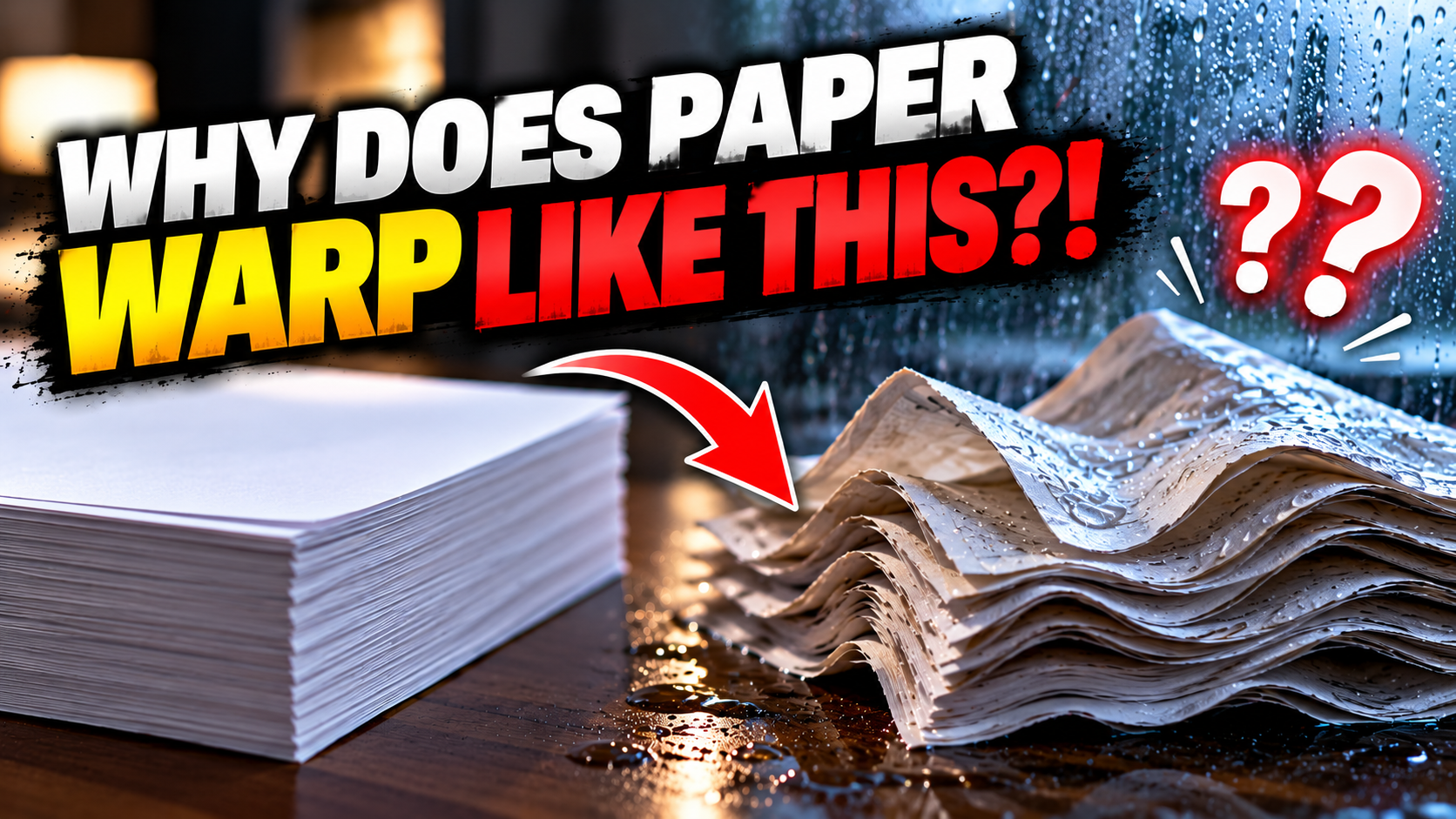
Have you ever opened an old book and noticed that its pages were no longer perfectly flat?
Perhaps the edges had curled, or the pages had developed a strange, wavy texture.
You may have seen something similar when painting on ordinary paper. As soon as water touches the surface, the sheet begins to buckle or bend.
Why does this happen?
Does paper simply become heavier when it absorbs moisture, or does something more complex occur within its structure?
The explanation involves cellulose fibers, water molecules, and the physical forces that develop when different parts of a sheet expand unevenly.
Although paper looks like a simple, flat material, it consists of a complex network of plant-based fibers.
These fibers interact continuously with moisture in the surrounding air.
As humidity changes, paper can absorb or release water, causing its dimensions and mechanical properties to change.
Scientists describe this moisture-sensitive behavior as hygroscopicity.
Another important concept is dimensional stability, which refers to a material’s ability to maintain its size and shape under changing environmental conditions.
In this article, we will explore why paper absorbs moisture, how water affects cellulose fibers, why sheets warp and wrinkle, and how humidity is managed in printing, art, and document preservation.
1. Why Does Paper Absorb Moisture from the Air?
Most conventional paper is made primarily from cellulose fibers obtained from plants.
Cellulose is a natural polymer consisting of long chains of glucose units.
Its molecular structure contains numerous hydroxyl groups.
These chemical groups can interact with water molecules through hydrogen bonding.
Because of these interactions, cellulose is naturally sensitive to moisture.
When the surrounding air becomes more humid, paper may absorb water vapor.
When the air becomes drier, paper may release some of the moisture it contains.
This ability to absorb and release moisture in response to the surrounding environment is known as hygroscopicity.
One important point is that paper does not need to come into direct contact with liquid water to absorb moisture.
Water vapor in the air is enough to change its moisture content.
This explains why books and documents can change shape during humid weather even when they have never been visibly wet.
2. What Determines the Moisture Content of Paper?
The moisture content of paper depends on several factors, including relative humidity, temperature, fiber composition, and surface treatments.
Relative humidity describes the amount of water vapor in the air compared with the maximum amount the air could contain at the same temperature, expressed as a percentage.
When relative humidity increases, paper generally tends to absorb more moisture.
When relative humidity decreases, paper tends to release moisture.
Over time, paper approaches a moisture balance with its environment.
This condition is described using the concept of equilibrium moisture content.
Equilibrium moisture content is the amount of moisture a material tends to contain after remaining under stable temperature and humidity conditions for a sufficient period.
However, different types of paper do not necessarily reach the same moisture content under identical conditions.
Fiber composition, coatings, fillers, and manufacturing processes can all influence moisture absorption.
There is another interesting complication.
Paper may contain slightly different amounts of moisture at the same relative humidity depending on whether it has been absorbing or releasing water.
This behavior is associated with sorption hysteresis.
It means that the moisture history of paper can influence its present condition.
3. Why Does Paper Expand When It Absorbs Water?
When paper absorbs moisture, water molecules interact with the cellulose fibers that form its structure.
These interactions can cause the fibers to swell.
Swelling occurs when a material takes up liquid or moisture and undergoes an increase in volume or dimensions.
In cellulose-based materials, water can affect the spacing and interactions between molecular structures.
As individual fibers swell, the dimensions of the paper sheet may also change.
However, paper is not a solid block of cellulose.
It is a network of overlapping, bonded fibers with microscopic spaces between them.
Because of this structure, swelling at the fiber level does not translate into a perfectly uniform expansion of the entire sheet.
The final dimensional change depends on fiber orientation, bonding, density, and other structural characteristics.
Another important point is that paper does not necessarily expand equally in every direction.
This directional difference plays a major role in paper warping.
4. Why Does Fiber Direction Matter?
During industrial papermaking, a dilute suspension of fibers is deposited onto a moving forming surface.
As the paper web forms, the fibers may become preferentially oriented in certain directions.
The direction in which the paper travels through the machine is called the machine direction, or MD.
The direction perpendicular to it is called the cross direction, or CD.
Paper can exhibit different mechanical and dimensional properties in these two directions.
This directional dependence is known as anisotropy.
In many machine-made papers, moisture-related dimensional changes are greater in the cross direction than in the machine direction.
This behavior is influenced by the orientation of cellulose fibers and the directional swelling characteristics of the fibers themselves.
As a result, the direction of the fibers can affect how paper expands, shrinks, curls, and responds to mechanical stress.
Fiber direction is particularly important in printing, bookbinding, and paper-based packaging.
5. Why Does Flat Paper Become Wavy?
Imagine a perfectly flat sheet of paper absorbing moisture evenly across its entire surface.
If every part expanded by the same amount and the sheet were free to move, the paper might change size without developing severe wrinkles.
However, real paper rarely absorbs moisture in a completely uniform way.
Different regions may absorb water at different rates.
For example, if water is applied to only one side of a sheet, the wet side may expand more than the dry side.
This creates a difference in strain between the two surfaces.
Because the two sides remain connected, the sheet may bend to accommodate that difference.
A similar problem occurs when only a small area becomes wet.
The wet region attempts to expand, while the surrounding dry paper restricts its movement.
These competing deformations can produce buckling, ripples, and wrinkles.
The final shape depends on the paper’s thickness, fiber orientation, surface treatment, and the distribution of moisture.
Therefore, paper warping is not simply the result of getting wet.
It is a mechanical response to uneven swelling and internal stresses.
6. Why Do Book Pages Become Wavy in Humid Weather?
Books are particularly sensitive to changes in environmental humidity.
A book contains many sheets of paper arranged in layers and connected through its binding.
As humidity changes, the pages absorb or release moisture.
However, different parts of a book may respond at different rates.
The exposed edges of pages can interact with surrounding air differently from areas closer to the binding.
This can create differences in moisture distribution.
The binding also restricts movement in certain regions.
While the outer edges of pages can move relatively freely, areas near the spine are mechanically constrained.
As the paper expands or contracts, these differences may create internal stresses.
The result can be curled edges, rippled pages, or a generally uneven appearance.
Rapid humidity changes may make these effects more noticeable.
However, the severity of the deformation depends on the paper type, binding method, storage conditions, and previous moisture exposure.
7. Why Is Watercolor Paper Different from Printer Paper?
Watercolor painting introduces substantial amounts of water onto a paper surface.
For this reason, watercolor paper is designed with different performance requirements from ordinary printer paper.
Many watercolor papers have a higher basis weight and greater thickness.
They may also receive internal or surface sizing treatments.
Sizing is a process used to control how paper interacts with liquids.
It can help regulate water absorption, paint spreading, and the behavior of pigments on the surface.
Thicker paper often provides greater resistance to bending than thinner paper.
However, thickness alone does not make paper completely resistant to moisture-related deformation.
Even high-quality watercolor paper can buckle when a large amount of water is applied unevenly.
Artists sometimes secure the edges of paper or use specific preparation methods to reduce distortion during painting.
The effectiveness of these techniques depends on the type of paper and the amount of water used.
Watercolor paper therefore illustrates how material design can help manage moisture while still allowing water-based artistic techniques.
8. Will Warped Paper Become Flat Again After Drying?
When wet paper dries, it releases moisture and some of the swelling may decrease.
However, the sheet does not always return to its original shape.
During wetting and drying, the fiber network can undergo changes in its arrangement and internal stresses.
Wrinkles and localized deformations may remain after the water has evaporated.
If the paper was constrained or subjected to pressure while wet, those conditions may also influence its final shape.
Uneven drying can create additional differences in shrinkage between neighboring regions.
This is one reason water-damaged books often retain wavy pages even after they are completely dry.
The final result depends not only on how much water was absorbed but also on the drying conditions and mechanical forces experienced by the sheet.
For valuable documents or historical materials, attempting to flatten damaged paper without professional guidance can cause further harm.
9. Why Is Dimensional Stability Important in Printing?
Modern printing requires accurate control of paper position and dimensions.
This is especially important when multiple colors are printed in separate stages.
If a sheet expands or contracts between printing operations, the positions of the printed colors may no longer align precisely.
This can create registration errors.
Even small dimensional changes may affect the quality of detailed images and text.
Moisture-related curling can also interfere with paper feeding and transport through printing equipment.
For these reasons, industrial printing operations pay attention to paper moisture and environmental conditions.
Allowing paper to adjust to the conditions of the printing room may help reduce changes during production.
Large differences between storage conditions and printing conditions can increase the likelihood of dimensional changes.
Dimensional stability is therefore an important material property that influences printing accuracy, efficiency, and consistency.
10. How Do Museums and Archives Control Humidity?
Museums, libraries, and archives must consider the long-term effects of environmental conditions on paper collections.
Because paper absorbs and releases moisture, repeated humidity changes can cause dimensional movement and mechanical stress.
Excessively high humidity may also increase the risk of mold growth.
On the other hand, excessively dry conditions can contribute to brittleness or handling difficulties in some paper-based materials.
For this reason, preservation professionals generally focus on maintaining appropriate and reasonably stable environmental conditions.
There is no single ideal humidity level that applies to every paper collection.
Suitable conditions depend on the type of material, its condition, the surrounding temperature, and the storage environment.
Conservation institutions assess these factors when establishing environmental management practices.
Avoiding sudden or extreme changes is often an important part of preventive conservation.
The goal is to reduce deterioration while maintaining conditions appropriate for the collection.
11. How Can You Protect Books and Paper Documents at Home?
Several simple storage habits can help reduce the risk of moisture-related paper deformation.
Avoid Areas with Large Humidity Changes
Try not to store books in locations where humidity changes dramatically.
Areas near poorly insulated exterior walls or windows may be more vulnerable to condensation.
Keep Paper Away from Direct Water Exposure
Bathrooms, kitchens, and other frequently damp spaces may not be ideal for long-term paper storage.
Water vapor and accidental splashes can affect paper materials.
Consider the Storage Environment
Books and documents benefit from storage conditions that avoid excessive moisture and extreme dryness.
However, strong airflow or rapid drying is not necessarily appropriate for fragile materials.
Use Suitable Storage Materials
Important documents may benefit from protective folders or boxes.
For long-term preservation, materials specifically designed for archival storage can be useful.
Handle Water-Damaged Documents Carefully
If a valuable document becomes wet, avoid aggressive flattening or exposing it to intense heat.
Important historical or irreplaceable materials should be assessed by a qualified conservator whenever possible.
The most effective approach is prevention through appropriate storage and environmental awareness.
12. A Simple Experiment: Watch Paper Warp When It Gets Wet
You can observe moisture-related deformation using a simple experiment at home.
You will need two sheets of the same type of paper, a small amount of water, a brush or dropper, and a flat surface.
Step 1: Prepare Two Sheets
Cut or select two sheets of paper with similar dimensions.
Place them on the same flat surface.
Step 2: Keep One Sheet Dry
Leave the first sheet untouched.
It will serve as a comparison sample.
Step 3: Wet Part of the Second Sheet
Use a brush or dropper to apply a small amount of water to one side of the second sheet.
Try to wet only a limited area.
Step 4: Observe the Changes
Watch the paper over the next several minutes.
Depending on the paper type and amount of water, the wet region may begin to swell.
The sheet may curl, buckle, or develop a wavy texture.
Step 5: Observe the Drying Process
Allow the paper to dry naturally.
Notice whether the deformation decreases, changes shape, or remains visible.
Step 6: Compare the Results
Compare the previously wet sheet with the dry sample.
The difference can help demonstrate how moisture affects the dimensions and mechanical behavior of paper.
However, the outcome depends on paper thickness, coatings, fiber direction, and the amount of water applied.
This experiment provides a simple visual demonstration rather than a precise measurement of dimensional stability.
13. Why Does Research on Paper Dimensional Stability Matter?
The study of paper hygroscopicity and dimensional stability has applications across many industries.
In packaging, changes in humidity can affect the dimensions and structural performance of paperboard products.
In printing, dimensional stability helps maintain accurate alignment and reliable paper transport.
In art materials, understanding moisture-related deformation helps manufacturers design paper for water-based media.
In libraries and archives, environmental management is essential for preserving valuable paper collections.
Paper-based functional materials and electronic devices may also need to account for dimensional changes caused by moisture.
These examples demonstrate that paper is not simply a passive surface for writing.
It is a responsive material whose properties depend on its internal structure and environmental conditions.
Understanding this behavior can improve product design, manufacturing processes, and preservation methods.
Conclusion: Why Humidity Changes the Shape of Paper
Paper warping begins with the interaction between moisture and cellulose fibers.
Cellulose contains chemical groups that can interact with water molecules.
As paper absorbs moisture, its fibers may swell and its dimensions can change.
When this expansion occurs unevenly, different regions of the sheet experience different strains.
These differences can produce bending, buckling, curling, and wrinkles.
Fiber orientation also plays an important role because paper often expands differently along its machine and cross directions.
This explains why humidity-related deformation is not always uniform or predictable.
The same principles are relevant to book storage, watercolor painting, printing technology, packaging, and archival preservation.
A sheet of paper may appear simple, but it is a complex material that continuously responds to its environment.
The next time you notice wavy book pages on a humid day, remember that the cellulose fibers inside the paper are interacting with moisture in the air.
Even an ordinary sheet of paper can reveal important principles of materials science.
Insight 50’s Paper Science series explains the structure, properties, manufacturing technologies, and everyday scientific behavior of paper through accessible, science-based articles.