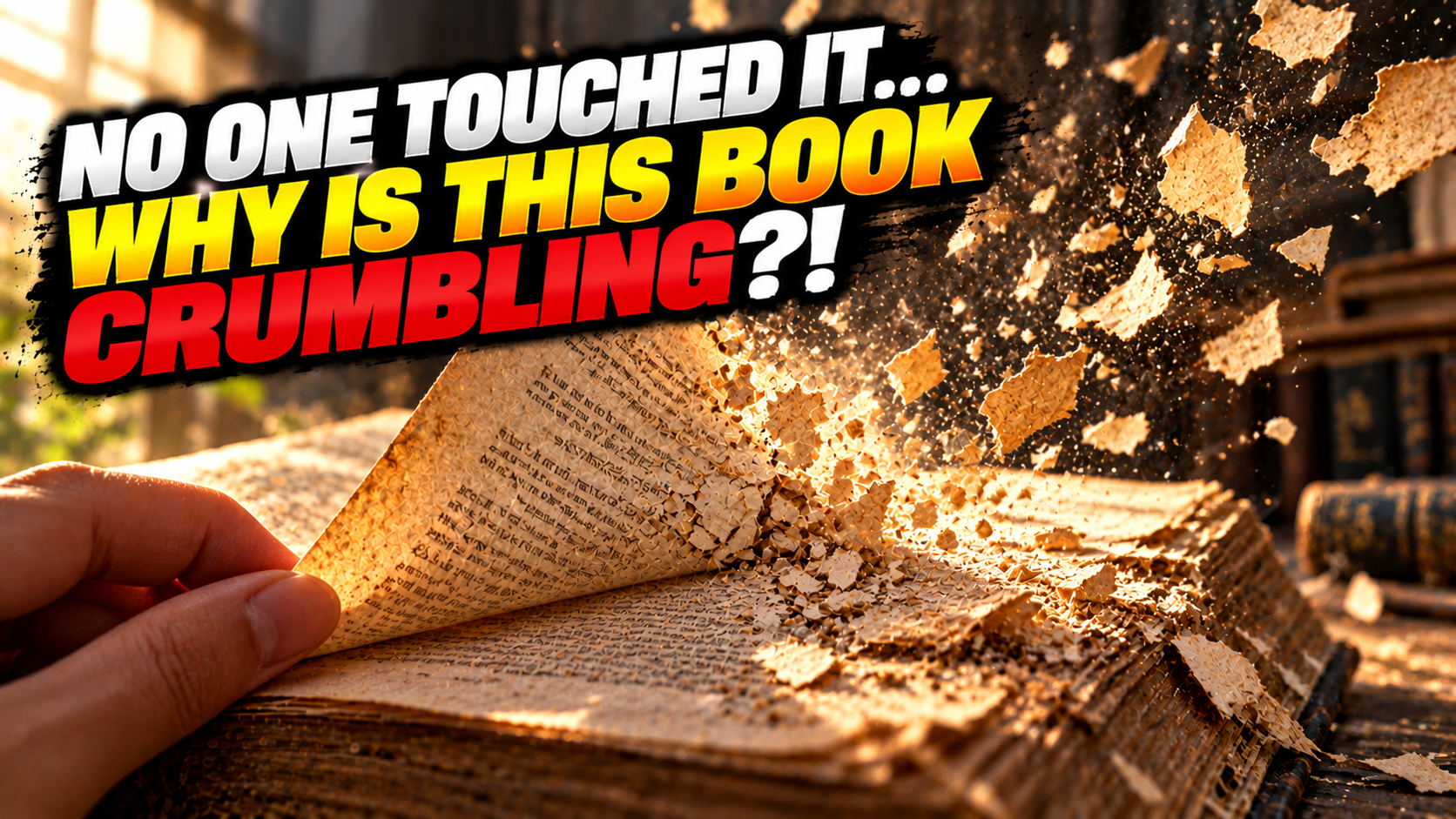
Imagine opening a book that has been sitting undisturbed on a library shelf for decades.
As you carefully turn a page, its edges begin to crack. Tiny fragments break away, and the paper feels unusually fragile.
Nothing dramatic has happened to the book. It has not been torn, soaked, or deliberately damaged.
Yet the paper has gradually lost its strength.
Why does this happen?
The answer lies in a series of chemical reactions taking place inside the paper itself.
Paper is primarily made from cellulose, a natural polymer composed of long molecular chains. Over time, these chains can undergo chemical degradation, reducing the material’s mechanical strength.
One of the most important degradation pathways is acid-catalyzed hydrolysis.
Under certain conditions, acidic compounds and moisture accelerate the breaking of chemical bonds within cellulose.
Some degradation processes can also produce acidic substances that contribute to further deterioration, creating a potential positive feedback mechanism.
This phenomenon is closely related to autocatalytic degradation.
Understanding these reactions is essential in paper conservation, archival science, polymer chemistry, and cultural heritage preservation.
In this article, we will examine why old paper becomes brittle, how cellulose molecules break down, what causes paper acidity, and how conservation specialists attempt to slow the deterioration of historic documents.
1. Why Does Paper Become Weaker Over Time?
Paper is made from a network of cellulose fibers.
These fibers overlap and bond together, creating the structure that gives paper its strength.
Cellulose itself is a natural polymer composed of repeating glucose units connected into long molecular chains.
These chains contribute to the structural integrity of the fibers.
However, cellulose is not chemically indestructible.
Over time, chemical reactions can break the molecular chains into shorter segments.
As degradation progresses, the physical properties of the paper may change.
The material may become less resistant to folding, bending, or handling.
Eventually, pages may crack or break apart under relatively small mechanical forces.
Several factors can contribute to this process.
These include acidity, moisture, oxygen, light, temperature, and the original composition of the paper.
The factors may act separately or interact with one another.
Therefore, the condition of an old book cannot be determined simply by its age.
The materials used during manufacturing and the conditions under which the book has been stored are equally important.
2. What Happens When Cellulose Molecular Chains Break?
Cellulose consists of glucose units connected by glycosidic bonds.
A polymer is a large molecule composed of many repeating structural units.
In cellulose, these units form long chains that contribute to fiber strength and mechanical stability.
However, chemical reactions can break glycosidic bonds.
This process is known as chain scission.
When molecular chains are broken, their average length may decrease.
As a result, the degree of polymerization of cellulose may become lower.
The degree of polymerization describes the number of repeating units in a polymer chain.
A significant reduction in cellulose polymerization can contribute to the loss of mechanical strength in paper.
For example, the paper may become more vulnerable to cracking during folding.
However, paper strength depends on more than molecular chain length.
Fiber dimensions, bonding between fibers, additives, moisture content, and manufacturing methods also influence mechanical performance.
Therefore, cellulose chain degradation is an important factor, but it is not the only explanation for paper brittleness.
3. What Is Acid-Catalyzed Hydrolysis?
Hydrolysis is a chemical reaction in which water participates in the breaking of chemical bonds.
In cellulose, hydrolysis can break the glycosidic bonds connecting glucose units.
Under acidic conditions, this process can occur more rapidly.
Acids can act as catalysts by facilitating the chemical reactions involved in bond cleavage.
As these bonds break, long cellulose chains become shorter.
Over time, the average degree of polymerization may decrease.
This can contribute to a gradual reduction in the strength of paper.
However, the presence of water does not mean that cellulose will immediately undergo extensive degradation.
The rate of hydrolysis depends on several factors.
These include acidity, temperature, moisture availability, and the structure of the cellulose material.
In documents stored for many decades or centuries, relatively slow reactions can accumulate into significant damage.
This is one reason why acidic paper may become fragile even when it has not experienced obvious physical abuse.
4. Why Does Paper Become Acidic?
Paper acidity can originate from several different sources.
Historically, some papermaking processes involved chemicals that could contribute to acidic conditions.
One important example is rosin-alum sizing.
Sizing is a treatment used to control how paper absorbs liquids such as water and ink.
In certain historical manufacturing processes, rosin and alum were used to modify the paper’s absorbency.
Depending on the formulation and conditions, these materials could contribute to the long-term acidity of the paper.
Other components may also influence acidity.
For example, oxidation and degradation of lignin or other substances present in the paper can contribute to the formation of acidic compounds.
Environmental pollutants may also affect the chemical condition of paper.
Therefore, paper acidity can result from a combination of manufacturing materials, fiber composition, and storage conditions.
Importantly, not all old paper is acidic.
Some historical papers remain chemically stable because of their original materials and manufacturing processes.
5. What Is Autocatalytic Paper Degradation?
An autocatalytic reaction is a process in which a product of a reaction contributes to accelerating that same reaction.
In paper degradation, acidic compounds may be produced or accumulate during certain chemical changes.
For example, oxidation and degradation of cellulose and other paper components can generate organic acids.
Under suitable moisture conditions, these acidic substances may contribute to additional acid-catalyzed hydrolysis.
This can create a positive feedback mechanism.
As degradation progresses, the chemical environment may become more favorable for further deterioration.
This is one reason autocatalytic behavior is discussed in studies of paper aging.
However, not all paper deterioration follows the same autocatalytic mechanism.
The actual degradation rate depends on the types of acids present, their mobility, moisture content, temperature, oxygen availability, and material composition.
Autocatalytic degradation is therefore a useful scientific concept, but it should not be treated as a universal explanation for every type of paper damage.
6. Is Yellowing the Same as Paper Brittleness?
Many old books develop yellow or brown pages.
It may seem reasonable to assume that yellow paper is always weaker than white paper.
However, discoloration and brittleness are not identical phenomena.
Yellowing is often associated with chemical changes that produce light-absorbing structures within the material.
Oxidation and photochemical reactions can contribute to these changes.
In papers containing lignin, reactions involving lignin-derived compounds may be especially important.
Brittleness, on the other hand, is related to the loss of mechanical strength.
Cellulose chain scission and changes in fiber bonding can contribute to this process.
Yellowing and brittleness may occur together because some environmental conditions promote both chemical discoloration and structural degradation.
However, a yellow sheet is not necessarily extremely brittle.
Likewise, a relatively pale sheet may have undergone significant molecular degradation.
For this reason, conservation specialists assess more than appearance when evaluating paper condition.
7. Why Is the Degree of Polymerization Important?
The degree of polymerization is an important indicator in cellulose degradation research.
A higher degree of polymerization generally means that cellulose molecules contain longer chains.
A lower value may indicate that molecular chain scission has occurred.
Researchers can investigate cellulose chain length through analytical methods related to molecular weight or solution viscosity.
These measurements can provide information about the condition of cellulose within a paper sample.
However, the degree of polymerization cannot describe every aspect of paper durability.
Mechanical strength also depends on fiber length, fiber orientation, bonding, fillers, and moisture.
Therefore, polymerization measurements should be interpreted alongside other physical and chemical properties.
In cultural heritage conservation, another challenge is that obtaining a sample may damage a valuable document.
For this reason, analytical techniques must be selected carefully, especially when working with rare books and historic manuscripts.
8. How Does Humidity Affect Paper Degradation?
Paper is a hygroscopic material.
This means it can absorb and release moisture from the surrounding air.
Moisture influences both the chemical stability and mechanical behavior of paper.
Water participates in hydrolysis reactions.
Under certain conditions, increased moisture availability can promote acid-catalyzed cellulose degradation.
However, the relationship between humidity and paper deterioration is not completely straightforward.
Moisture also affects flexibility and mechanical behavior.
Extremely dry conditions can make handling certain materials more difficult and may increase the risk of physical damage.
On the other hand, high humidity can increase the likelihood of mold growth, dimensional changes, and other problems.
Therefore, conservation does not simply involve making paper as dry as possible.
Instead, specialists aim to maintain appropriate and stable environmental conditions.
Rapid fluctuations in relative humidity can cause repeated expansion and contraction of paper.
These changes may contribute to mechanical stress and distortion.
9. Does Higher Temperature Make Paper Deteriorate Faster?
Temperature influences the rates of many chemical reactions.
In general, higher temperatures can accelerate several processes involved in cellulose degradation.
As a result, warm storage environments may be unfavorable for the long-term preservation of paper.
Scientists sometimes study these relationships using the Arrhenius equation.
The Arrhenius equation describes how a reaction rate constant depends on temperature under an appropriate kinetic model.
Researchers may conduct accelerated aging experiments by exposing paper samples to controlled conditions.
The purpose is to investigate degradation mechanisms and estimate how materials might behave over longer periods.
However, accelerated aging results must be interpreted carefully.
It is not always valid to convert a short high-temperature experiment directly into a precise number of years of natural aging.
Different temperatures and humidity conditions may alter the dominant degradation mechanisms.
Therefore, reliable lifetime predictions require carefully designed experiments and validated models.
10. Why Can Some Historic Papers Survive for Centuries?
Not all paper deteriorates at the same rate.
Some historical papers were produced from fibers such as cotton or flax.
Depending on their processing, these materials may contain relatively high proportions of cellulose and low levels of lignin.
They may also have been manufactured without strongly acidic additives.
Such characteristics can contribute to long-term chemical stability.
However, this does not mean that all historical paper is superior to modern paper.
Modern manufacturers also produce neutral and alkaline papers designed for long-term preservation.
The durability of paper depends on the original fibers, manufacturing process, additives, and storage environment.
Therefore, the year a sheet was produced is not enough to predict its condition.
Its chemical composition and environmental history are often more informative.
11. What Is the Difference Between Neutral and Alkaline Paper?
The acidity or alkalinity of paper is one factor affecting its long-term stability.
Under suitable conditions, paper with neutral or alkaline characteristics may be less vulnerable to acid-catalyzed cellulose hydrolysis than strongly acidic paper.
Some archival papers are manufactured using alkaline papermaking processes.
Calcium carbonate may be included as a filler or alkaline reserve.
An alkaline reserve can help neutralize acidic substances that are present in or introduced into the paper.
This may improve resistance to certain acid-related degradation processes.
However, alkaline paper is not immune to aging.
Oxidation, light exposure, heat, and inappropriate humidity can still damage the material.
Therefore, good storage conditions remain important even when paper has been designed for long-term preservation.
12. What Is Paper Deacidification?
Deacidification is a conservation treatment intended to reduce or neutralize acidic substances in paper.
Some methods use alkaline compounds to counteract acidity.
By reducing acidic conditions, these treatments may help slow acid-catalyzed cellulose hydrolysis.
However, deacidification has an important limitation.
It does not automatically reconnect cellulose molecular chains that have already been broken.
Therefore, it cannot fully restore the original strength of severely degraded paper.
Its primary purpose is to reduce the risk of further acid-related chemical deterioration.
Different treatment methods may also affect inks, pigments, coatings, or other materials within a document.
For this reason, deacidification must be selected according to the specific properties of the object.
Historic manuscripts and valuable books should not be treated with household chemicals or improvised conservation methods.
Professional evaluation is essential when dealing with culturally important materials.
13. How Do Libraries Preserve Fragile Books?
Libraries, archives, and museums use several strategies to slow paper deterioration.
One of the most important is environmental management.
Temperature and relative humidity are controlled to reduce unfavorable chemical and physical changes.
Avoiding rapid environmental fluctuations is also important.
Light exposure may be limited, particularly when materials are sensitive to photochemical degradation.
Protective folders and archival boxes can reduce exposure to dust, pollutants, and mechanical damage.
Fragile books may also require specialized supports during handling.
In some cases, institutions provide digital copies to reduce the frequency with which original documents must be handled.
However, digitization does not directly stop chemical degradation in the original paper.
It is a complementary preservation strategy that helps protect information and reduce physical wear.
14. Can Scientists Measure the Acidity of Paper?
Paper acidity can be evaluated using pH-related measurements.
The pH scale describes the acidity or alkalinity of an aqueous solution.
However, paper is a solid material, so measuring its acidity requires appropriate methods.
Researchers may analyze aqueous extracts of paper or use techniques designed to assess surface pH.
The results can vary depending on the measurement procedure and experimental conditions.
Furthermore, the surface and interior of a paper sheet may not have identical chemical characteristics.
A single pH value therefore cannot fully describe the long-term preservation condition of a document.
Other factors, including cellulose degradation, fiber composition, and mechanical strength, must also be considered.
For valuable cultural objects, analytical methods should be selected to minimize the risk of damage.
15. How Can You Store Old Books More Safely at Home?
You do not need a professional conservation laboratory to follow basic principles of paper preservation.
One useful step is to avoid prolonged exposure to direct sunlight.
Light and heat can contribute to chemical changes in paper.
It is also advisable to avoid areas with excessive humidity or frequent environmental fluctuations.
Spaces affected by condensation or mold are particularly unsuitable for storing books.
Books should be protected from unnecessary physical stress, dust, and environmental contaminants.
If a book is already brittle, avoid forcing its pages open or repeatedly folding damaged sections.
Do not apply homemade deacidification solutions or other chemicals to valuable books.
Such treatments may cause permanent damage.
If a document has significant historical, financial, or personal value, consult a qualified paper conservator before attempting restoration.
16. Why Do Scientists Study Autocatalytic Paper Aging?
Research into paper degradation has applications beyond preserving old books.
Cellulose is an important component of many plant-derived materials.
Understanding its chemical stability can therefore contribute to research on other bio-based products.
Polymer chain scission, oxidation, and moisture-dependent reactions are major topics in materials science.
In conservation research, understanding these processes helps specialists design storage conditions and evaluate treatment strategies.
In modern papermaking, the same knowledge can support the development of more durable materials.
Researchers can investigate how manufacturing additives, fiber composition, and environmental conditions influence long-term performance.
Ultimately, paper aging research connects cultural heritage preservation with polymer chemistry, chemical kinetics, and materials engineering.
Conclusion: Old Paper Can Deteriorate Through Chemical Reactions Within Its Structure
Old books do not become brittle simply because time has passed.
Their physical deterioration can result from chemical changes occurring within the cellulose fibers.
One important process is acid-catalyzed hydrolysis.
Under suitable conditions, acids and moisture can promote the breaking of glycosidic bonds in cellulose.
As molecular chains become shorter, the mechanical properties of the paper may weaken.
Acidic substances produced or accumulated during degradation may also contribute to conditions that promote further deterioration.
This is one reason autocatalytic mechanisms are studied in paper conservation science.
However, paper aging is a complex process.
Oxidation, light, temperature, humidity, manufacturing methods, and material composition can all influence the outcome.
Preserving paper therefore requires attention to both its chemistry and its storage environment.
Neutral or alkaline paper, stable environmental conditions, and professionally selected conservation treatments can help reduce certain forms of deterioration.
The gradual crumbling of an old book is not merely a visible sign of age.
It is evidence that the molecular structure of a familiar material can change through slow chemical reactions over many years.
Understanding these processes helps explain why some documents survive for centuries while others become fragile within a much shorter period.
Insight 50’s Paper Science series explores the structure, physical and chemical properties, manufacturing technologies, and advanced applications of paper through accessible explanations grounded in materials science.