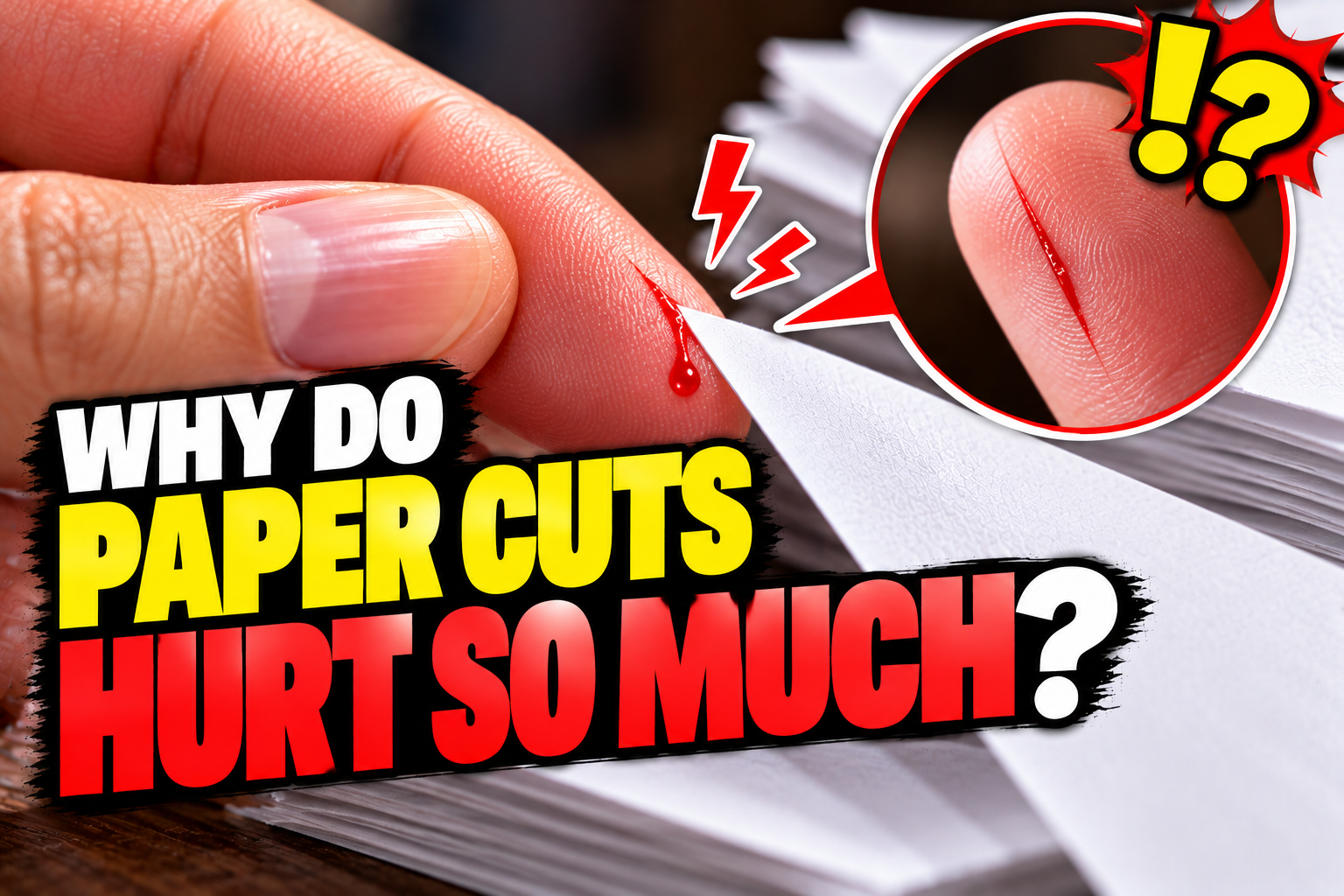
Have you ever been flipping through a book, opening an envelope, or organizing documents when the edge of a sheet of paper suddenly sliced your finger?
At first, the injury might look insignificant.
There may be only a tiny red line on your skin, sometimes with barely any visible blood.
Yet the pain can be surprisingly intense.
Washing your hands becomes uncomfortable. Picking up everyday objects can make the wound sting again. Even a small movement of your finger may remind you that the cut is still there.
This raises a fascinating question: Why can such a small injury hurt so much?
Is paper somehow more dangerous than it looks? Does its rough edge make the wound especially painful? Or is something happening inside our skin?
The answer involves a combination of physics, human anatomy, and the nervous system.
Paper cuts often occur on sensitive parts of the fingers, where pain-detecting nerve endings respond to tissue damage. The wound can also become irritated by repeated movement and everyday contact.
In this article, we’ll explore why paper can cut skin, what makes paper cuts painful, why they sometimes bleed very little, and how to care for them properly.
1. How Can Something as Soft as Paper Cut Your Skin?
Paper seems like a harmless material.
It bends easily, tears with relatively little force, and feels much softer than a knife or a piece of metal.
So how can it slice through human skin?
The answer has less to do with the overall hardness of paper and more to do with the way force becomes concentrated along a narrow edge.
When a sheet of paper moves quickly across your finger, its thin edge may press against a very small area of skin.
This concentrates mechanical stress.
If the local stress exceeds what the skin can withstand, the tissue can split.
The angle of contact also matters.
A sheet of paper sliding across your skin at an unfortunate angle may create a cutting action even though the same sheet feels harmless when touched flat.
Not all paper has the same cutting potential.
Thickness, edge condition, stiffness, movement speed, and the amount of force applied can all influence whether a cut occurs.
A flexible sheet may seem harmless during ordinary handling but still cause an injury when its edge moves across the skin in the wrong way.
2. Why Are Our Fingertips So Sensitive?
One reason paper cuts can be particularly noticeable is that they often occur on our fingers.
Human hands are highly specialized for touch and precise movement.
We use our fingertips to recognize textures, manipulate small objects, type, write, and perform countless everyday tasks.
To support these abilities, the skin of the fingertips contains a rich system of sensory receptors.
Different receptors respond to mechanical stimuli such as pressure, vibration, and skin deformation.
The skin also contains pain-sensing nerve endings called nociceptors.
Nociceptors respond to potentially harmful stimuli and signals associated with tissue damage.
When the skin is cut, these sensory pathways can become activated, sending signals through the nervous system.
The brain processes these signals as part of the experience of pain.
However, there is an important distinction.
Having a high density of touch receptors does not automatically mean that every injury to the fingertips must be more painful than an injury elsewhere.
Pain depends on several factors, including the type of tissue damage, the nerves involved, inflammation, and individual sensitivity.
Still, because our fingers are both sensitive and constantly in use, even a small injury can become difficult to ignore.
3. Why Can a Tiny Paper Cut Hurt So Much?
The size of a wound does not always predict how painful it will feel.
A small injury can activate pain-sensitive nerve endings even when the visible damage is limited.
When paper cuts the skin, the tissue is disrupted.
This injury can activate nociceptors and initiate a local inflammatory response.
During inflammation, the body releases chemical signals that help coordinate tissue repair and immune activity.
Some of these signals can also increase the sensitivity of nearby pain-sensing nerves.
As a result, the injured area may react more strongly to touch, pressure, or movement.
This is one reason a paper cut can continue to sting after the initial injury.
The location of the wound matters too.
A cut on a fingertip or along a finger joint may be repeatedly disturbed throughout the day.
Typing on a keyboard, opening a door, or picking up a phone can all place pressure on the affected area.
Even though the wound is small, these repeated interactions may keep reminding you of the injury.
Paper cuts are therefore a good example of how pain depends on more than the visible size of a wound.
4. Are Paper Edges Really Rough Under a Microscope?
A sheet of paper may look smooth and evenly cut to the naked eye.
But paper is made from a network of cellulose fibers.
At a microscopic level, its structure is much more complicated.
Depending on how the paper was manufactured and cut, its edge may contain irregularities, broken fibers, and uneven features.
These microscopic characteristics can influence how the edge interacts with skin.
However, one popular explanation deserves caution.
You may have heard that paper cuts hurt more than knife cuts because paper acts like a tiny saw and produces a much more jagged wound.
While paper edges can be irregular, it is not scientifically accurate to assume that every paper cut is more jagged or more painful than every knife cut.
The actual injury depends on the material, the sharpness of the edge, the angle of contact, and the force involved.
Likewise, a wound caused by a sharp knife can be extremely painful and potentially much more serious.
The microscopic structure of paper may contribute to how a cut occurs, but it is only one part of the explanation.
The nervous system and the location of the injury are also important.
5. Why Do Paper Cuts Sometimes Barely Bleed?
One of the strangest things about a paper cut is that it may hurt intensely without producing much visible blood.
How is that possible?
The explanation begins with the layers of human skin.
The outermost major layer is called the epidermis.
Below it lies the dermis, which contains blood vessels, nerves, and other structures.
The epidermis itself does not contain blood vessels.
Therefore, a very superficial injury that remains within the epidermis may produce little or no visible bleeding.
If a cut extends into the dermis and damages small blood vessels, bleeding may occur.
The amount of bleeding depends on the depth and location of the injury, as well as which vessels are affected.
Pain and bleeding are related to different biological processes.
Pain involves the activation and processing of sensory signals.
Bleeding occurs when blood vessels are damaged.
This means a wound can be painful without causing substantial bleeding.
However, the absence of visible blood does not reliably tell you the exact depth or seriousness of every injury.
A cut that is deep, gaping, or associated with numbness should be assessed appropriately, regardless of how much it bleeds.
6. Why Do Paper Cuts Sting When You Wash Your Hands?
Many people notice that a paper cut becomes especially uncomfortable when it comes into contact with water or soap.
This happens partly because the protective barrier of the skin has been disrupted.
Healthy skin helps shield underlying tissues from external substances and physical irritation.
When the skin is cut, that barrier is damaged.
The injured region may become more sensitive to contact, movement, and certain chemical stimuli.
Inflammation can also increase the responsiveness of nearby pain-sensing nerves.
During handwashing, several things happen at once.
Water flows over the wound.
The skin moves as you rub your hands together.
Soap and other substances may contact the injured area.
These combined stimuli can make the cut sting.
However, this does not mean you should avoid cleaning the wound.
Gently rinsing a minor cut with clean running water is an important part of basic wound care.
Keeping the area clean helps remove debris and reduces unnecessary contamination.
7. Why Can a Paper Cut Keep Hurting for Days?
A paper cut may seem like a minor inconvenience, but it can remain noticeable while the skin heals.
One reason is the constant movement of the hands.
Think about how often you use your fingers during a typical day.
You type messages, prepare food, wash dishes, open containers, turn pages, and handle personal belongings.
A cut in a frequently used location may be stretched, pressed, or rubbed repeatedly.
These actions can irritate the wound and trigger pain.
The healing process itself also involves changes in the injured tissue.
Inflammation, cellular activity, and tissue repair take place as the body restores the damaged skin.
During this period, the area may remain sensitive.
Most uncomplicated, superficial paper cuts heal without major problems when kept clean and protected.
However, repeated irritation can make the injury more uncomfortable.
A wound that becomes increasingly painful, swollen, red, or warm may require medical evaluation, particularly if there are signs of infection.
8. How Should You Treat a Paper Cut?
Most small paper cuts can be managed with basic first aid.
However, even a minor injury deserves appropriate care.
Step 1: Wash Your Hands
Before touching the wound, clean your hands to reduce the chance of introducing additional dirt or microorganisms.
Step 2: Control Any Bleeding
If the cut is bleeding, apply gentle, steady pressure with clean gauze or a clean cloth.
Minor bleeding often stops with direct pressure.
If bleeding is heavy or does not stop with sustained pressure, seek medical attention.
Step 3: Rinse the Wound
Gently rinse the cut under clean running water.
This helps remove debris and surface contamination.
You can clean the surrounding skin with mild soap.
Avoid aggressively scrubbing the wound.
Step 4: Avoid Harsh Cleaning Chemicals
Repeatedly applying rubbing alcohol or hydrogen peroxide directly to a minor open wound is generally not recommended.
These products can irritate tissue.
Clean running water is usually sufficient for rinsing a simple superficial cut.
Step 5: Protect the Injury
After cleaning, a thin layer of plain petroleum jelly may help keep the wound from drying out excessively.
Covering the area with an appropriate adhesive bandage or dressing can protect it from friction and contamination.
Change the dressing when it becomes wet or dirty.
Step 6: Watch for Warning Signs
Seek medical care if the wound is deep, widely separated, associated with numbness or difficulty moving the finger, or continues to bleed.
Also watch for signs of infection, such as spreading redness, increasing swelling, warmth, pus, or fever.
Depending on the wound and your vaccination history, you may also need to review whether your tetanus immunizations are up to date.
For a typical clean, superficial paper cut, serious complications are uncommon, but proper wound care remains important.
9. Can You Prevent Paper Cuts?
Paper cuts often happen unexpectedly.
They may occur while sorting paperwork, handling envelopes, or flipping through a stack of documents.
Although it is impossible to eliminate every risk, a few habits can help.
Avoid quickly sliding your fingers along exposed paper edges.
When handling large stacks of paper, pay attention to how the sheets move across your hands.
Try not to pull paper rapidly through tightly closed fingers.
If your work involves frequent handling of large quantities of paper, consider whether your workflow or appropriate protective equipment could reduce accidental contact with sharp edges.
It is also helpful to remember that the edge of a sheet can be more hazardous than its broad, flat surface.
Simple awareness can reduce unnecessary injuries.
10. What Do Paper Cuts Teach Us About Pain?
Paper cuts offer an interesting lesson about the human nervous system.
Pain is not a simple measurement of how large an injury looks.
Instead, it is an experience produced through complex biological processes.
Sensory nerve activity, tissue damage, inflammation, body location, and individual factors all influence how pain is experienced.
A tiny cut on a frequently used finger may be more noticeable than a larger injury in a less frequently disturbed location.
This does not mean that small injuries are always more painful.
Rather, it shows why visible wound size alone is not enough to predict the intensity of pain.
Paper cuts also demonstrate the importance of the skin as a protective barrier.
Even a small break in that barrier can expose the injured area to repeated irritation.
By understanding these mechanisms, we can better appreciate why a seemingly harmless sheet of paper can produce such an unpleasant sensation.
Conclusion: Why Do Paper Cuts Hurt More Than You Expect?
Paper cuts can be surprisingly painful because several factors work together.
The thin edge of a sheet can concentrate force against the skin, causing a small injury.
If the cut activates pain-sensitive nerve endings, the nervous system responds to the tissue damage.
Local inflammation can increase sensitivity around the wound.
And because paper cuts frequently occur on fingers that we use throughout the day, the injured area may be repeatedly irritated.
A paper cut may also bleed very little if the injury is superficial and does not damage blood vessels.
But minimal bleeding does not necessarily mean minimal pain.
The discomfort is not caused by a mysterious chemical in the paper or by one universally proven feature of its edge.
It is better explained by the interaction between the paper, the skin, and the body’s pain-processing system.
The next time a sheet of paper unexpectedly cuts your finger, remember that the pain has a biological explanation.
Clean the wound, protect it from unnecessary friction, and give the skin time to heal.
Sometimes, even the smallest everyday injuries reveal something fascinating about how the human body works.
Insight 50’s Paper Science series explores the surprising science behind everyday paper products and the ways they interact with our lives.