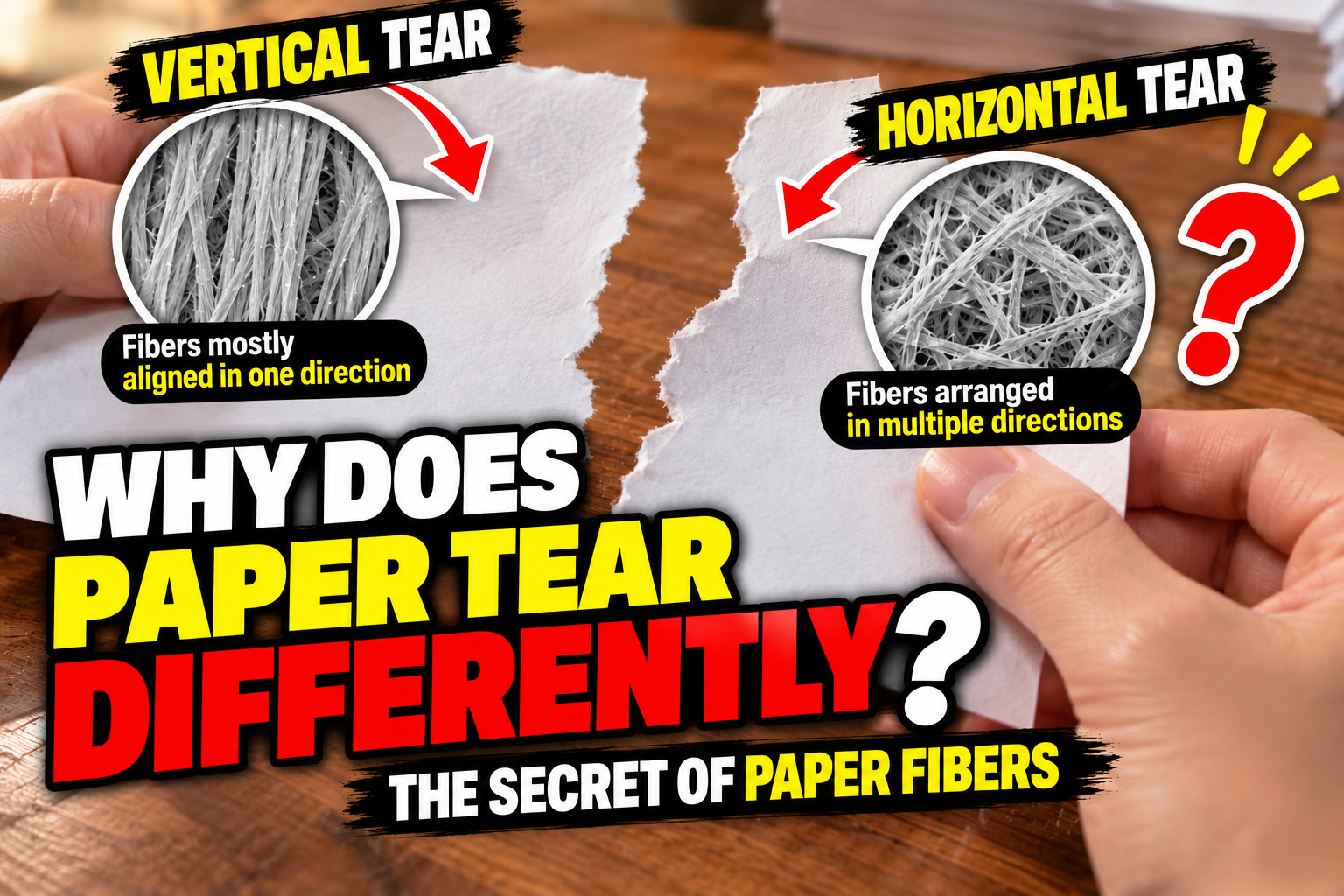
Have you ever noticed that a sheet of paper sometimes tears in a nearly straight line, while other times the tear becomes uneven and jagged?
You might be using the same sheet of paper, applying a similar amount of force, and tearing at roughly the same speed. Yet the results can look surprisingly different.
Why does this happen?
The answer is hidden inside the paper itself.
Although paper looks like a smooth, uniform material, it is actually made of countless microscopic plant fibers connected to one another.
During manufacturing, these fibers may become more aligned in one direction than another.
This arrangement can affect how paper stretches, bends, and tears.
In materials science, this phenomenon is related to a property called anisotropy, which means that a material behaves differently depending on the direction in which it is tested.
Understanding this property helps explain not only why paper tears differently, but also why paper grain matters in bookbinding, printing, and packaging.
Let’s explore the hidden structure of paper and discover how its fibers influence the way it tears.
1. What Is Paper Made Of?
To understand how paper tears, we first need to examine its structure.
Most ordinary paper is manufactured using pulp obtained from wood.
Wood pulp contains cellulose, a natural polymer that forms an important part of plant cell walls.
Cellulose consists of long molecular chains built from repeating glucose units.
During papermaking, pulp fibers are mixed with water to create a suspension.
This mixture is then spread into a thin layer, and much of the water is removed.
As the material dries, the fibers become intertwined and form bonds with neighboring fibers.
The result is a thin sheet that holds together even though it is made from many individual fibers.
Under a microscope, paper looks very different from the smooth surface we see with our eyes.
Instead of a solid, continuous material, it resembles a complicated network of overlapping fibers.
The strength of this network depends on several factors, including fiber length, fiber properties, bonding, and the arrangement of fibers within the sheet.
These characteristics also influence what happens when someone tries to tear the paper.
2. Why Are Paper Fibers Often Aligned in One Direction?
Modern paper is commonly produced using large industrial papermaking machines.
During manufacturing, a mixture of water and pulp fibers flows onto a moving forming surface.
As water drains away, the fibers gradually form a continuous sheet.
The direction in which the paper travels through the machine is called the machine direction, or MD.
The direction perpendicular to it is called the cross direction, or CD.
These two directions are important because the fibers may not be distributed in exactly the same way along both axes.
As the pulp suspension moves through the manufacturing process, fluid flow and machine conditions can cause some fibers to become preferentially aligned with the machine direction.
This does not mean every fiber points in exactly the same direction.
Paper still contains a complex network of fibers crossing and overlapping one another.
However, even a moderate preference for one direction can influence the mechanical properties of the finished sheet.
This is one reason paper may behave differently when pulled, folded, or torn in different directions.
3. What Is Paper Grain?
The term paper grain generally refers to the predominant direction of fiber alignment in a sheet of paper.
In many machine-made papers, this direction is associated with the machine direction.
Paper grain is not always visible to the naked eye.
A sheet may appear perfectly uniform even when its internal structure has a directional preference.
However, the grain can influence several properties, including stiffness, dimensional stability, and folding behavior.
For example, paper may bend more easily in one orientation than another.
It may also expand or contract differently along different directions when exposed to changes in humidity.
These differences are especially important in professional printing and book production.
A paper manufacturer may specify whether a sheet is long grain or short grain, depending on how its grain direction relates to its dimensions.
Understanding grain direction helps printers and bookbinders choose the correct orientation for their projects.
4. Why Does Paper Tear Differently Depending on Direction?
Tearing paper involves more than simply separating a thin sheet into two pieces.
At a microscopic level, several processes may occur.
Some fibers break.
Some bonds between neighboring fibers separate.
Other fibers may be pulled partly out of the surrounding network.
The amount of energy required for these processes depends on the structure of the paper.
If fibers are preferentially aligned in a particular direction, a tear traveling along that direction may interact with the network differently from a tear traveling across it.
As a result, the force required to continue tearing and the appearance of the torn edge may vary with direction.
For example, some machine-made papers tend to produce a straighter tear along the grain than across it.
However, this is not a universal rule.
A tear does not always require less force when it follows the grain.
The outcome also depends on fiber length, bonding strength, sheet thickness, the way the tear begins, and how the force is applied.
The important scientific principle is that paper’s internal structure can create directional differences in its tearing behavior.
That is why two tears made in perpendicular directions may produce noticeably different results.
5. Is Paper Strength the Same as Tear Resistance?
When people describe paper as strong, they often assume that it must also be difficult to tear.
But paper strength is not a single property.
Scientists and manufacturers measure several different mechanical characteristics.
Two important examples are tensile strength and tear resistance.
Tensile Strength
Tensile strength describes how much pulling stress a material can withstand before breaking.
Imagine holding opposite ends of a paper strip and pulling them apart.
The force required to break the strip is related to its tensile properties.
Paper often shows different tensile behavior in the machine direction and the cross direction.
Tear Resistance
Tear resistance describes a material’s ability to resist the continuation of a tear.
Imagine making a small cut in a sheet and then pulling the two sides apart.
The resistance you feel as the tear spreads depends on how fibers break, separate, and interact with the surrounding network.
A paper can have relatively high tensile strength without necessarily having equally high tear resistance.
This distinction is important when selecting materials for products that need to withstand different types of stress.
For example, a packaging material may need to resist stretching, while another product may need to prevent small cuts from developing into larger tears.
Therefore, the word strong does not tell us everything about how paper will perform.
6. Why Does Paper Grain Matter in Bookbinding?
One of the most practical applications of paper grain is bookbinding.
A book contains many pages that need to bend smoothly when opened and turned.
The direction of the paper grain can influence how naturally those pages move.
In traditional bookbinding, the preferred grain direction of the pages generally runs parallel to the spine.
This arrangement helps the pages bend more comfortably when the book is opened.
If the grain runs perpendicular to the spine, the pages may resist bending or feel stiffer.
The book may also have more difficulty lying open naturally.
Grain direction can influence how pages respond to humidity changes as well.
For these reasons, professional bookbinders often pay close attention to paper orientation before cutting, folding, and assembling pages.
A detail that most readers never notice can make a meaningful difference in how a finished book feels.
7. How Does Paper Grain Affect Printing and Packaging?
Paper grain also matters in industrial applications.
Printing
Printing requires careful control of paper dimensions and alignment.
Paper can absorb moisture from the surrounding air, causing small changes in size.
Because its fiber structure may be directionally oriented, those dimensional changes can differ between the machine direction and cross direction.
In precision printing, even small changes can affect registration, which is the accurate alignment of different printed elements.
Paper orientation can also influence feeding, curling, and finishing operations.
Packaging
Paperboard and cardboard are used to manufacture boxes, containers, and protective packaging.
These materials must withstand forces during handling, transportation, and storage.
Depending on the product, manufacturers may consider bending stiffness, compression resistance, and other mechanical properties.
Since some paper-based materials behave differently along different directions, orientation can influence package performance.
This is one reason the internal structure of paper matters far beyond ordinary writing and drawing.
8. Can You Identify Paper Grain by Tearing It?
You can sometimes observe the effects of paper grain with a simple experiment.
All you need is a sheet of ordinary printer paper.
First, cut two rectangular pieces of similar size from the same sheet.
Make sure the pieces are oriented perpendicular to each other relative to the original sheet.
Next, try tearing one piece along its length.
Then tear the second piece in the perpendicular direction.
Compare the results.
Does one tear follow a straighter path?
Does the other produce a more irregular edge?
Do you notice a difference in the resistance you feel?
Some papers may show clear directional differences, while others may show very little.
However, tearing alone is not a perfectly reliable way to determine the exact machine direction.
The results can be influenced by how you hold the paper, the direction of the applied force, and small variations in the sheet.
For a more meaningful experiment, repeat the process several times using pieces cut from the same type of paper.
Look for consistent patterns rather than relying on a single tear.
9. Can You Detect Paper Grain by Bending It?
Another simple method involves comparing how paper bends in different orientations.
Start with a sheet of printer paper.
Cut two strips of identical length and width, making one strip parallel to the sheet’s long edge and the other parallel to its short edge.
Hold one end of each strip horizontally and allow the free end to extend outward.
Observe how much each strip bends downward under its own weight.
Paper can have different bending stiffness depending on direction.
Therefore, one strip may sag more than the other.
However, the difference may be small, and factors such as thickness, humidity, and cutting accuracy can affect the result.
This activity is best understood as an observation of directional behavior rather than a precise laboratory test.
For reliable measurements, researchers use standardized testing equipment and controlled conditions.
Still, this simple experiment can reveal that a seemingly uniform sheet of paper may behave differently depending on its orientation.
10. Does Every Type of Paper Have the Same Grain Structure?
Not all paper has the same degree of directional fiber alignment.
Manufacturing methods can create different fiber arrangements.
Many industrially produced papers have some degree of preferential fiber orientation.
However, certain handmade papers may have a more varied fiber distribution.
The type of pulp also matters.
Long fibers and short fibers can form networks with different mechanical properties.
Fiber processing, pressing, drying, and surface treatments may further influence the finished material.
Even two sheets with similar thickness and appearance can behave differently when torn.
For this reason, it is not always possible to identify grain direction simply by looking at the shape of a sheet.
The important factor is the orientation of the fibers inside the paper, not whether the sheet itself is rectangular or square.
11. A Simple Paper-Tearing Science Experiment
If you want to explore paper’s directional properties more carefully, try this experiment at home.
Materials
You will need several sheets of printer paper, scissors, a ruler, and a pencil.
Step 1: Mark the Directions
Place a sheet of paper on a table.
Mark its original horizontal and vertical directions.
Step 2: Prepare the Samples
Cut several strips of equal size.
Make half of the strips in one orientation and the remaining strips perpendicular to it.
Step 3: Begin the Tears
Make a small starting cut of similar length in each strip.
Try to tear the strips using a similar motion and speed.
Step 4: Compare the Results
Observe the torn edges.
Record whether the tears are relatively straight or irregular.
Notice whether one direction seems to offer more resistance.
Step 5: Repeat the Experiment
Repeat the test with several samples.
If similar differences appear repeatedly, they may indicate directional properties in the paper.
If the results are inconsistent, that is useful information too.
The paper may have relatively weak directional differences, or the variations introduced by hand tearing may be larger than the differences you are trying to observe.
This experiment demonstrates an important principle of materials science.
The microscopic structure of a material can influence its visible behavior.
Conclusion: The Direction of a Tear Reveals the Hidden Structure of Paper
Paper may look simple, but its internal structure is surprisingly complex.
Each sheet contains a network of cellulose fibers connected through physical interactions and bonding.
During manufacturing, these fibers may become preferentially aligned in a particular direction.
This alignment can create differences in the way paper stretches, bends, and tears.
The scientific term for direction-dependent material behavior is anisotropy.
Paper grain is one practical expression of this property.
It helps explain why some tears appear straighter than others and why grain direction matters in bookbinding, printing, and packaging.
However, fiber orientation is only one factor affecting tearing behavior.
Fiber length, bonding, paper thickness, and the way force is applied all influence the final result.
The next time you tear a sheet of paper, try comparing two perpendicular directions.
You may discover that an ordinary piece of paper contains a hidden structure that influences how it behaves.
Sometimes, even the simplest everyday materials reveal fascinating scientific principles when we examine them more closely.
Insight 50’s Paper Science series explores the hidden structure and scientific properties of everyday paper products through clear explanations and simple experiments.