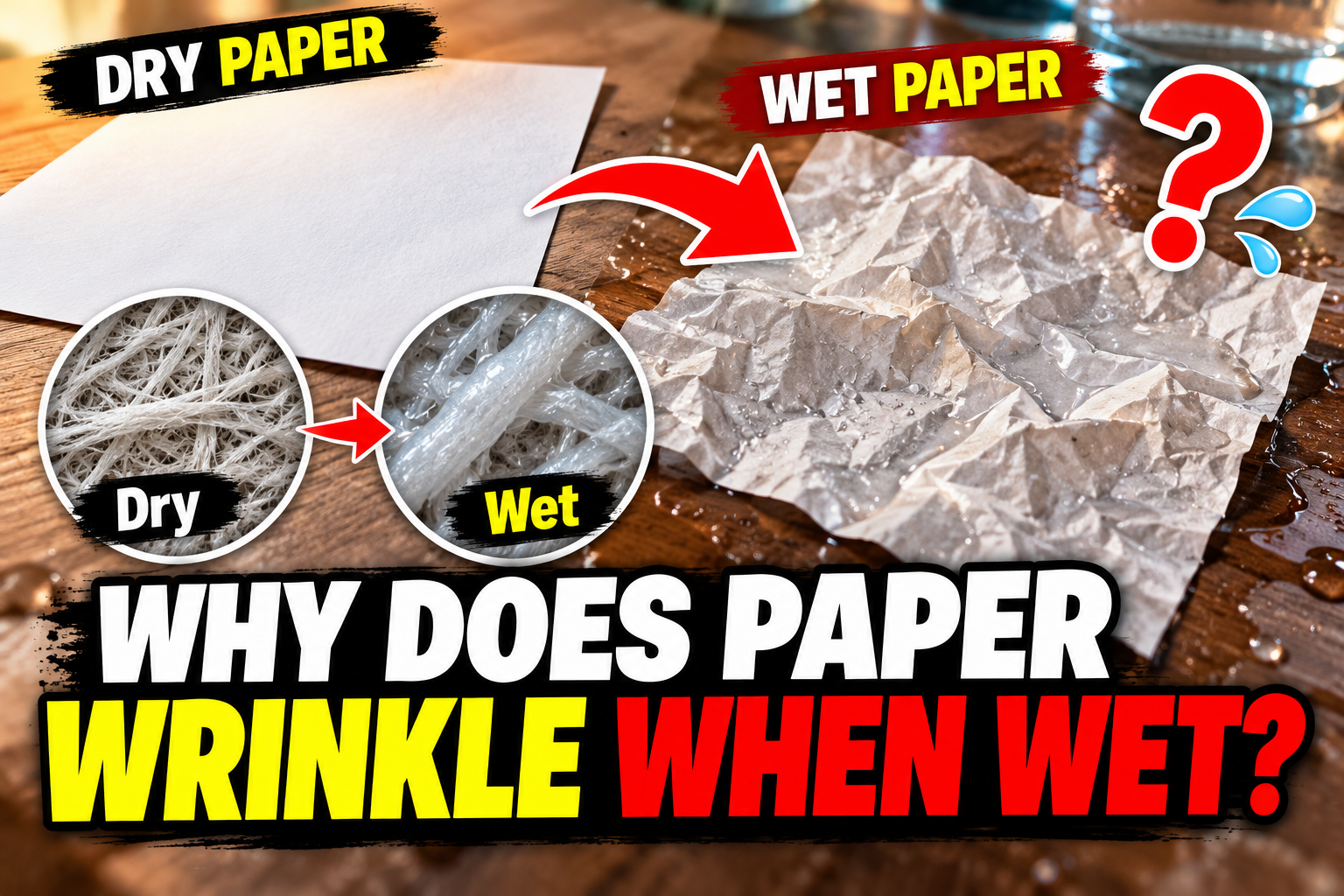
Have you ever accidentally spilled water on a book, notebook, or important document?
Even after the paper dries completely, it often looks different. The once-smooth surface becomes wavy, uneven, or covered with wrinkles.
You might try flattening it with your hands, but the paper rarely returns to its original condition.
Why does this happen?
The answer lies in the microscopic structure of paper and the way plant fibers react to moisture.
Paper may look like a simple, flat material, but it is actually made of countless tiny fibers that absorb water, expand, and interact with one another.
When those fibers change shape unevenly, the entire sheet can bend and wrinkle.
In this article, we will explore why paper wrinkles when wet, what happens inside its fibers, why drying does not always restore its original shape, and how to handle wet books and documents safely.
1. What Is Paper Actually Made Of?
To understand why paper wrinkles when wet, we first need to examine what paper is made of.
Most ordinary paper is produced from wood pulp, which contains large amounts of cellulose.
Cellulose is a natural polymer found in plant cell walls. It consists of long chains of glucose molecules connected together.
These molecules contain chemical groups called hydroxyl groups, which can interact with water molecules through hydrogen bonding.
During papermaking, wood pulp fibers are suspended in water and spread into a thin layer.
As the water is removed and the sheet dries, the fibers become intertwined and form bonds with one another.
The result is a thin, flexible material that can hold together without being woven like fabric.
Under a microscope, however, paper does not look like a perfectly smooth surface.
Instead, it resembles a complicated network of overlapping plant fibers with tiny spaces between them.
This structure gives paper many of its useful properties, including flexibility and strength.
It also explains why paper is so sensitive to moisture.
2. What Happens When Paper Absorbs Water?
When water touches a sheet of paper, it begins moving into the spaces between its fibers.
Some of the water also enters accessible regions within the cellulose fibers themselves.
Because cellulose contains hydroxyl groups, water molecules can interact with the fibers through hydrogen bonding.
As the fibers absorb moisture, they begin to swell.
This process is known as hygroscopic swelling.
However, paper does not expand equally in every direction.
Individual cellulose fibers generally undergo greater dimensional changes across their width than along their length.
The arrangement of fibers within the sheet also affects how the paper expands.
During industrial papermaking, fibers often become preferentially aligned in the direction the paper travels through the machine.
As a result, the finished sheet may expand more in one direction than another when exposed to moisture.
This directional behavior is one reason paper can curl, stretch, or change shape in unexpected ways.
And when different parts of a sheet absorb different amounts of water, the effects become even more noticeable.
3. Why Does Wet Paper Become Wrinkled?
The main reason wet paper wrinkles is uneven expansion.
Imagine placing a few drops of water in the center of a perfectly flat sheet.
The wet area begins absorbing moisture, causing its fibers to swell.
Meanwhile, the surrounding dry paper remains relatively unchanged.
The wet area now wants to occupy slightly more space, but the surrounding material restricts that expansion.
This creates mechanical stress within the sheet.
Because paper is thin and flexible, it may bend out of its original flat plane to relieve some of that stress.
The result can be ripples, waves, or wrinkles.
This behavior is related to a physical phenomenon called buckling.
Buckling occurs when a thin material bends or deforms under certain compressive stresses.
You can observe similar behavior when a thin sheet is pushed inward from opposite sides.
Instead of remaining perfectly flat, it may rise into small waves.
Wet paper behaves somewhat similarly, although the stress comes from uneven swelling rather than simply pushing the sheet with your hands.
In short, one part of the paper expands while another part resists that expansion.
The resulting imbalance causes the sheet to wrinkle.
4. Why Doesn’t Paper Become Flat Again After Drying?
If water makes paper fibers swell, shouldn’t removing the water make everything return to normal?
Not necessarily.
When wet paper dries, much of the absorbed water leaves the fibers, allowing them to shrink.
However, the internal structure of the sheet may not return to exactly the same arrangement it had before becoming wet.
While the paper is moist, fibers can shift slightly relative to one another.
Some bonds between fibers may change as water enters and later leaves the structure.
During drying, new bonding arrangements can form.
Different parts of the sheet may also dry at different rates.
For example, the edges might lose moisture faster than the center, producing uneven shrinkage.
These changes can leave residual deformation in the paper.
That is why a dried sheet may remain wavy even though it no longer feels damp.
The final shape depends on several factors, including how much water the paper absorbed, how evenly it became wet, and how it was dried.
Some minor wrinkles can be reduced through careful flattening, but severely distorted paper may not fully recover its original appearance.
5. Do Different Types of Paper Wrinkle Differently?
Yes. Not all paper reacts to water in the same way.
The amount of swelling and distortion depends on several properties, including fiber composition, thickness, manufacturing methods, and surface treatments.
Let’s compare three common types of paper.
Newspaper
Newspaper is generally thin and can absorb water relatively quickly.
When it becomes wet, it may lose strength and deform easily.
Because of its lightweight structure, wrinkles and waves can become especially noticeable.
Printer Paper
Ordinary printer paper is designed to work well in printing and copying equipment.
Its moisture absorption is controlled to some extent during manufacturing.
However, when exposed to enough water, printer paper can still expand, curl, and wrinkle.
A sheet that has been soaked and dried may no longer feed smoothly through a printer.
Watercolor Paper
Watercolor paper is specifically manufactured for painting with water-based pigments.
It is often thicker than standard printer paper and may contain treatments that influence how water enters the sheet.
Some watercolor papers also use fiber compositions and manufacturing processes that improve their performance when wet.
However, even watercolor paper can buckle if too much water is applied.
Artists sometimes stretch or secure watercolor paper before painting to reduce unwanted distortion.
These examples show that thickness matters, but it is not the only factor determining how paper behaves when wet.
The structure and treatment of the fibers are equally important.
6. How Is Water-Resistant Paper Made?
Paper manufacturers use several techniques to control how much water paper absorbs.
One important method is called sizing.
Sizing involves adding certain substances to the paper or treating its surface to modify liquid absorption.
Without suitable treatment, water-based inks may spread too quickly through the fiber network.
Sizing helps manufacturers control this behavior.
Surface coatings can also reduce the speed at which water penetrates paper.
For example, some packaging materials and paper cups use special barrier layers to help resist liquids.
These treatments are useful because ordinary cellulose fibers naturally interact with water.
However, water resistance and waterproofing are not the same thing.
A water-resistant sheet may tolerate small amounts of moisture or brief contact with liquid.
That does not necessarily mean it can remain submerged without absorbing water or becoming damaged.
The effectiveness of a treatment depends on the material, its intended use, and the duration of water exposure.
7. How to Dry Wet Paper Without Making the Damage Worse
If you accidentally spill water on an important document or book, your first reaction might be to dry it as quickly as possible.
But using excessive heat or handling the paper roughly can make the damage worse.
Here are several precautions worth following.
Avoid Rubbing the Wet Surface
Wet paper can be weaker than dry paper.
Rubbing its surface may damage the fibers or cause certain inks to smear.
Instead, handle the sheet gently and avoid unnecessary friction.
Remove Excess Water Carefully
If water remains on the surface, use a clean, absorbent material to gently blot it.
Avoid dragging the material across the page.
Blotting is generally safer than rubbing because it reduces mechanical stress on the wet fibers.
Avoid Direct High Heat
Using a hair dryer at a high temperature may seem convenient.
However, strong heat and uneven drying can contribute to further distortion.
Gentle air circulation is usually preferable for ordinary documents when conditions allow.
Allow the Paper to Dry Before Attempting Flattening
For a single ordinary sheet, careful drying followed by appropriate flattening may reduce some wrinkles.
However, applying heavy pressure while the sheet is still wet can cause sticking, surface damage, or ink transfer.
The safest approach depends on the type of paper and the materials printed or written on it.
Seek Professional Help for Valuable Documents
Historical manuscripts, photographs, rare books, and irreplaceable records require special care.
If the ink is bleeding, pages are sticking together, or the material is fragile, attempting a home repair may cause permanent damage.
Professional conservators have specialized methods for handling water-damaged materials.
Large quantities of wet books may also develop mold if they are not treated promptly.
For valuable collections, professional guidance is the safest option.
8. Why Does Humidity Matter Even When Paper Is Not Wet?
Paper does not need to be soaked to react to moisture.
It can absorb water vapor directly from the surrounding air.
This means changes in indoor humidity can affect paper even when no liquid water touches it.
When relative humidity increases, paper may absorb additional moisture and expand.
When humidity decreases, it may lose moisture and contract.
These dimensional changes can be important in printing, bookbinding, and packaging.
For example, commercial printing requires careful alignment of text and images.
If the dimensions of a sheet change during production, different printed layers may no longer line up precisely.
Similarly, cardboard packaging can change its mechanical properties when exposed to humid conditions.
Excessive moisture can reduce the strength of some paper-based packaging materials.
That is why paper manufacturers, printers, and storage facilities often pay close attention to environmental conditions.
Humidity control is not just about preventing visible water damage.
It can also help maintain dimensional stability and product quality.
9. A Simple Experiment to See Paper Swelling in Action
You can observe the effects of water on paper with a simple experiment at home.
You will need three small sheets of different paper types, such as newspaper, printer paper, and watercolor paper.
Place each sheet on a separate flat, water-safe surface.
Use a dropper to place approximately the same amount of water in the center of each sheet.
Then observe what happens over several minutes.
You may notice differences in how quickly the water spreads.
Some sheets may curl or develop visible ripples, while others remain relatively flat for longer.
Allow the samples to dry naturally and compare their final shapes.
Do the wrinkles disappear?
Does one type of paper remain flatter than the others?
The results will depend on the specific papers and conditions, but the experiment can help demonstrate how fiber structure and manufacturing methods influence moisture response.
It also shows that paper is not an inert material.
Even an ordinary sheet can change shape when its environment changes.
Conclusion: Wrinkled Paper Reveals the Behavior of Its Fibers
Paper wrinkles when wet because its cellulose fibers absorb moisture and expand.
When different regions of a sheet swell by different amounts, mechanical stresses develop within the paper.
Because the sheet is thin and flexible, it may bend or buckle, producing visible waves and wrinkles.
Drying removes much of the absorbed water, but it does not always restore the original fiber arrangement.
Changes in bonding, uneven shrinkage, and residual deformation can leave the paper permanently distorted.
The extent of this effect depends on the type of paper, its manufacturing process, and the way it becomes wet and dries.
This simple everyday phenomenon reveals something fascinating about a material we often take for granted.
A sheet of paper may look smooth and motionless, but its microscopic fibers are constantly responding to the surrounding environment.
The next time you see a wrinkled page after a water spill, remember that those waves are evidence of the hidden movements of countless plant fibers.
Insight 50’s Paper Science series explores the fascinating science behind everyday paper products, explaining familiar phenomena through accessible scientific principles.